
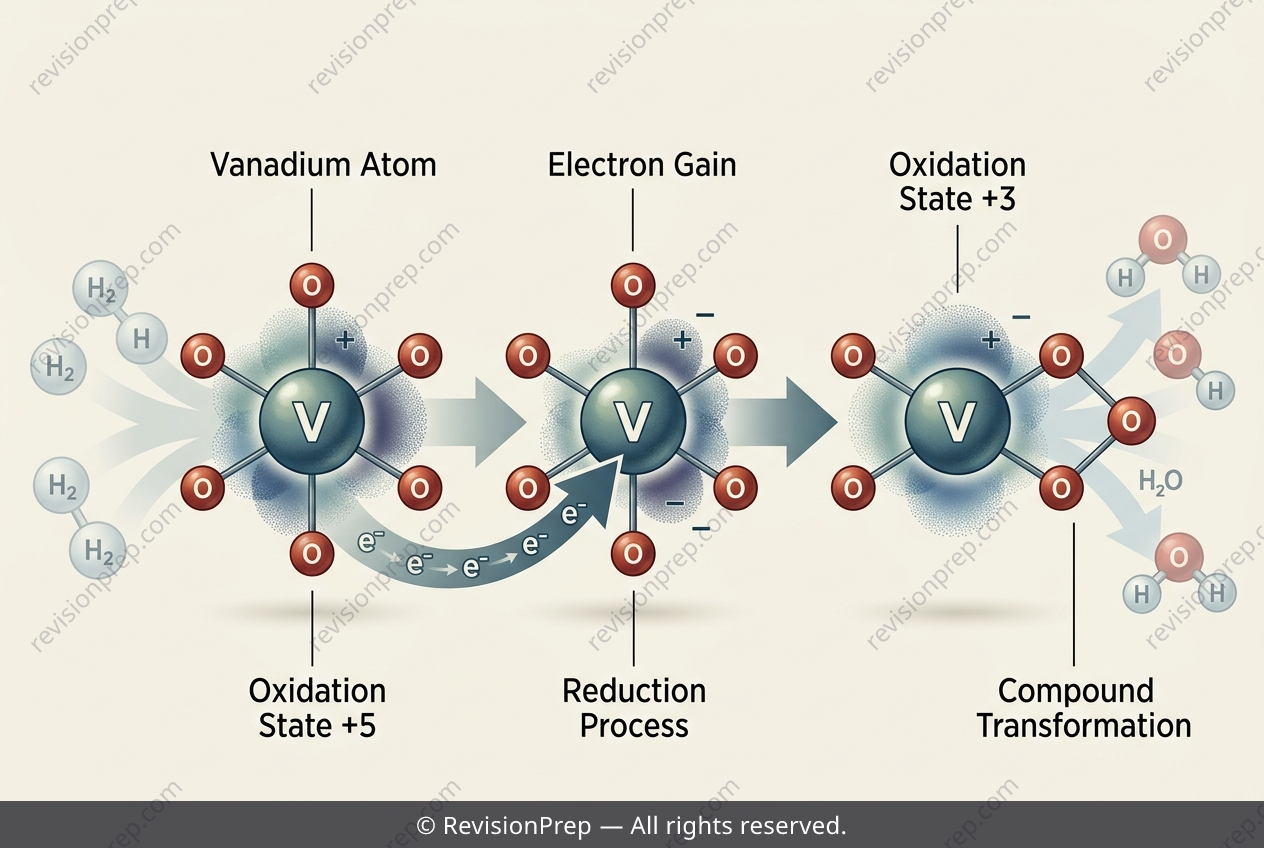
Chemistry: V₂O₅ and the Math of Electron Flow
Oxidation states are the bookkeeping system chemists use to track electrons during a reaction, assigning each atom a formal charge based on its bonding environment. In redox chemistry, these numbers reveal the heart of the process: which species loses electrons (is oxidized) and which gains them (is reduced). For transition metals like vanadium, which can adopt multiple stable oxidation states, this tracking becomes essential for predicting reactivity and balancing complex equations. The concept hinges on a simple algebraic relationship: in a neutral compound, the sum of all oxidation states multiplied by their respective atom counts must equal zero. For an oxide like V₂O₅, oxygen is assigned a fixed state of −2, allowing the vanadium’s state to be solved directly. When a reaction transforms one oxide into another, the change in oxidation state per metal atom—not the total change across the formula unit—defines the stoichiometry of electron transfer. This per-atom perspective is what connects the macroscopic mass of a reactant to the microscopic flow of electrons, linking balanced equations to the fundamental driving force of redox reactions.
Start practising IB questions today
150,000+ IB-styled questions, criteria-mapped and instantly accessible.