
Chemistry: Volume Shifts Equilibrium, Heat Changes Kc
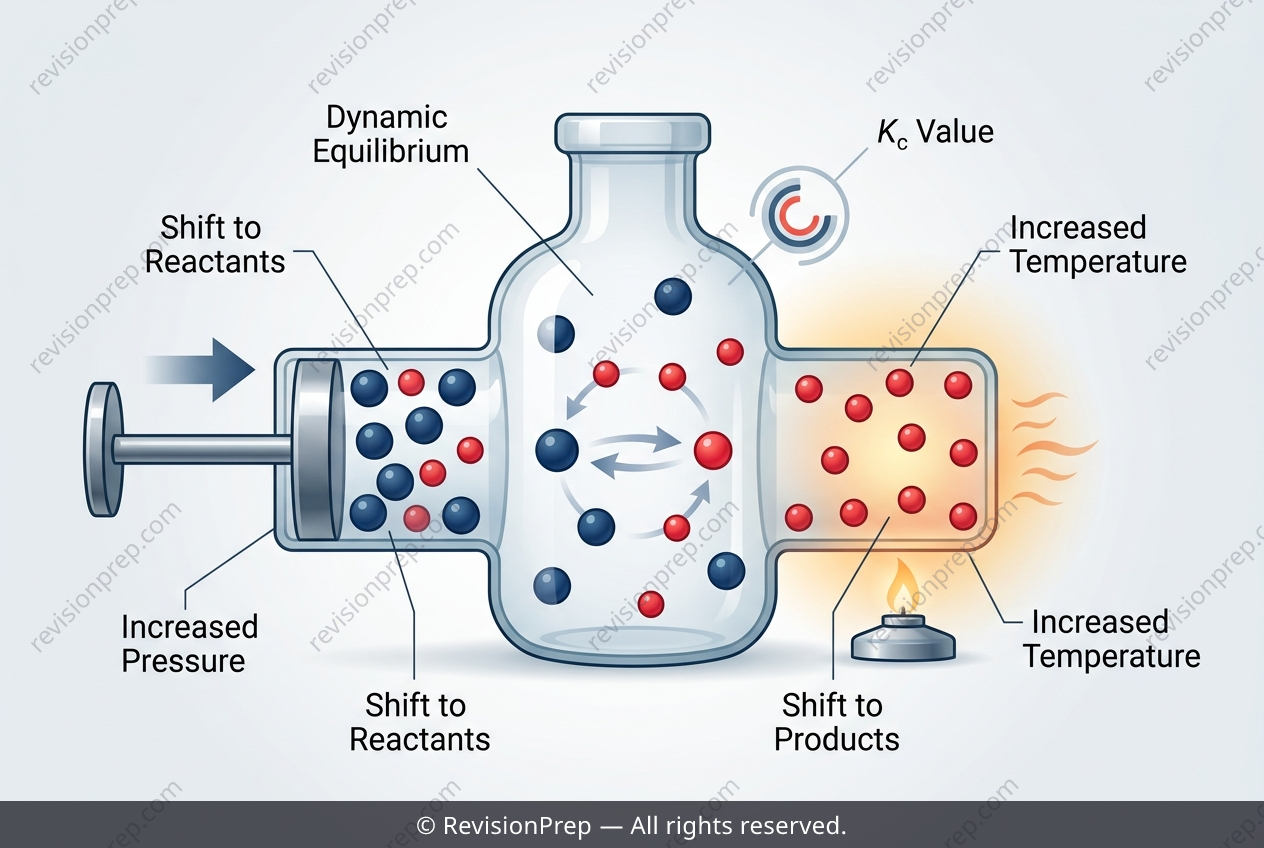
Chemical equilibrium describes the delicate balance point where the forward and reverse reactions occur at the same rate, leaving concentrations unchanged—yet that balance is not fixed. In this post, we explore the reaction PCl₅(g) ⇌ PCl₃(g) + Cl₂(g), an endothermic decomposition that perfectly illustrates how conditions like volume and temperature can tip the scales. Le Chatelier’s Principle predicts that a system at equilibrium will counteract any imposed change, so reducing the container’s volume shifts the position toward fewer gas moles—here, toward the reactant side. Meanwhile, the equilibrium constant Kc, defined as Kc = [PCl₃][Cl₂] / [PCl₅], quantifies the ratio of product to reactant concentrations at a given temperature. For this reaction, the initial moles of PCl₅ and the equilibrium amount of Cl₂ allow you to deduce all equilibrium concentrations, then plug them into the Kc expression. Crucially, because ΔH is positive, raising the temperature favours the forward, endothermic direction, increasing Kc itself. Understanding how Kc changes with temperature—and how volume shifts position without changing Kc—connects the quantitative and qualitative sides of reactivity, forming a cornerstone of IB Chemistry SL.
Start practising IB questions today
150,000+ IB-styled questions, criteria-mapped and instantly accessible.