
Chemistry: Why Alloying Makes Metals Harder to Bend
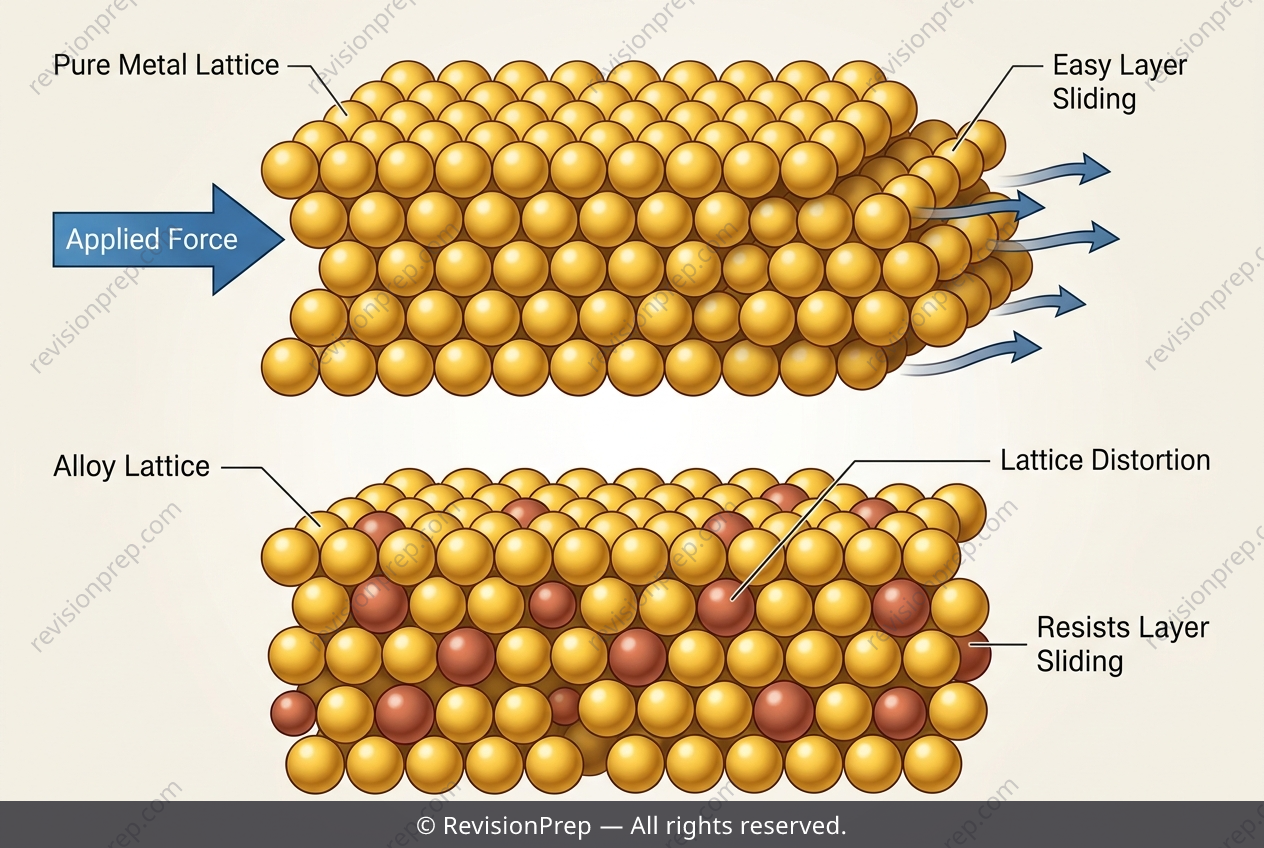
Pure metals are often too soft for practical applications, which is why metallurgists design alloys. In the context of bonding and structure, this difference comes down to how atoms are arranged and how they respond to stress. Metallic bonding relies on a sea of delocalised electrons, allowing atoms to slide past one another without breaking the structure—this is the origin of malleability. However, when a second element is introduced, the picture changes. In a substitutional alloy, such as 18-carat gold (75% Au, 25% Cu), copper atoms replace some gold atoms in the face-centred cubic lattice. Crucially, copper atoms are smaller than gold atoms. This size mismatch distorts the otherwise regular, repeating lattice, creating local strain and disrupting the perfect planes of atoms. When a force is applied, these distorted regions act as barriers: they hinder the movement of dislocations—line defects that normally allow layers to slip easily. Consequently, the layers in the alloy cannot slide past one another as readily as they can in pure 24-carat gold, where the uniform lattice permits easy slip. The result is that the alloy resists permanent bending, while the pure metal deforms far more easily under the same small force.
Start practising IB questions today
150,000+ IB-styled questions, criteria-mapped and instantly accessible.