
Chemistry: Why Atoms Shrink Across a Period
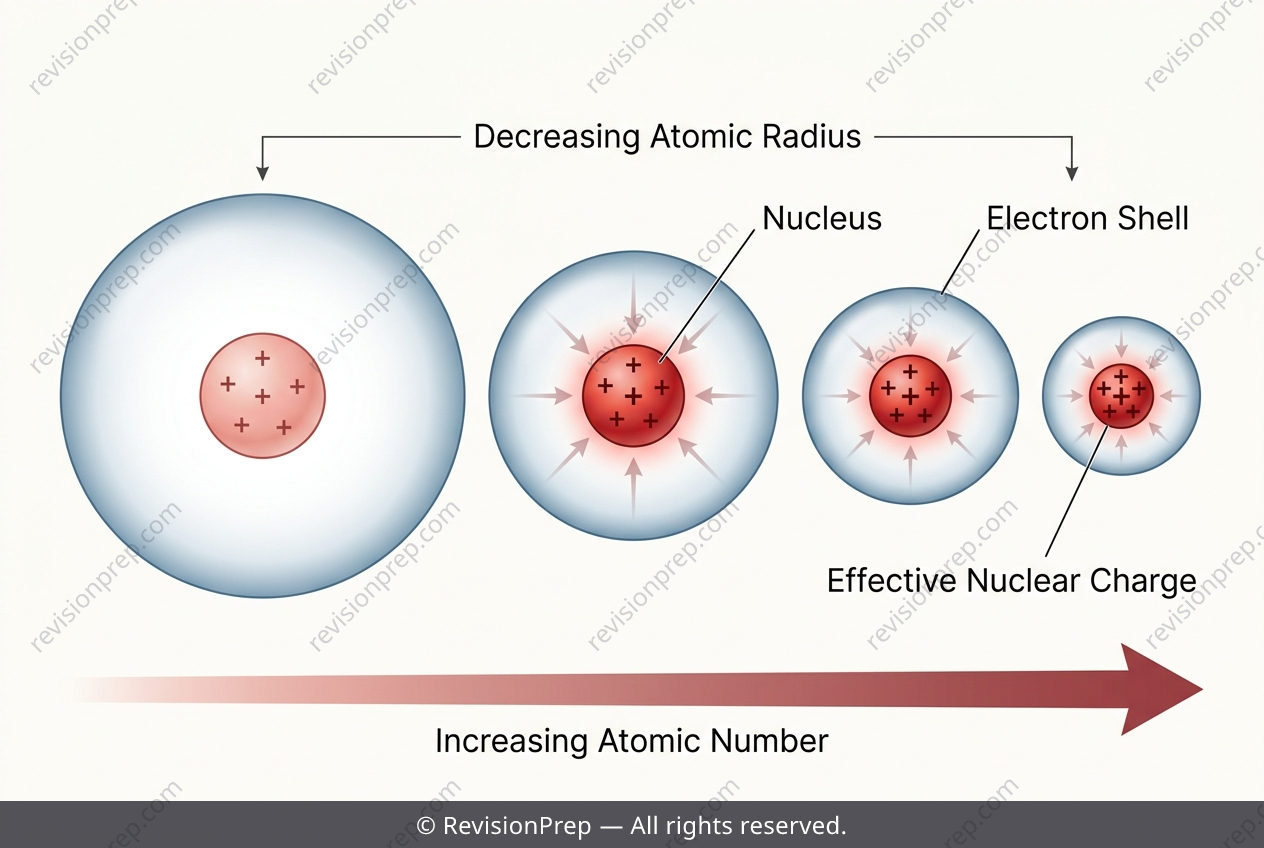
Across a single period of the periodic table, atomic radius follows a strikingly consistent trend: it decreases as you move from left to right. This happens because, while each successive element adds a proton to the nucleus, the added electrons occupy the same principal energy level. The increasing positive nuclear charge pulls the entire electron cloud inward, shrinking the atom’s overall size. This concept is central to understanding elemental behaviour, from ionisation energy to electronegativity. The key relationship is that effective nuclear charge (Z_eff) rises steadily across a period, overpowering the slight increase in electron-electron repulsion. Consequently, for any three consecutive elements, the one with the smallest radius must have the highest atomic number, and the largest radius belongs to the lowest atomic number. Recognising this inverse relationship between radius and atomic number lets you predict relative positions in the periodic table without memorising specific values—just by comparing their measured sizes.
Start practising IB questions today
150,000+ IB-styled questions, criteria-mapped and instantly accessible.