
Chemistry: Why Concentration Changes Rate, Not Energy
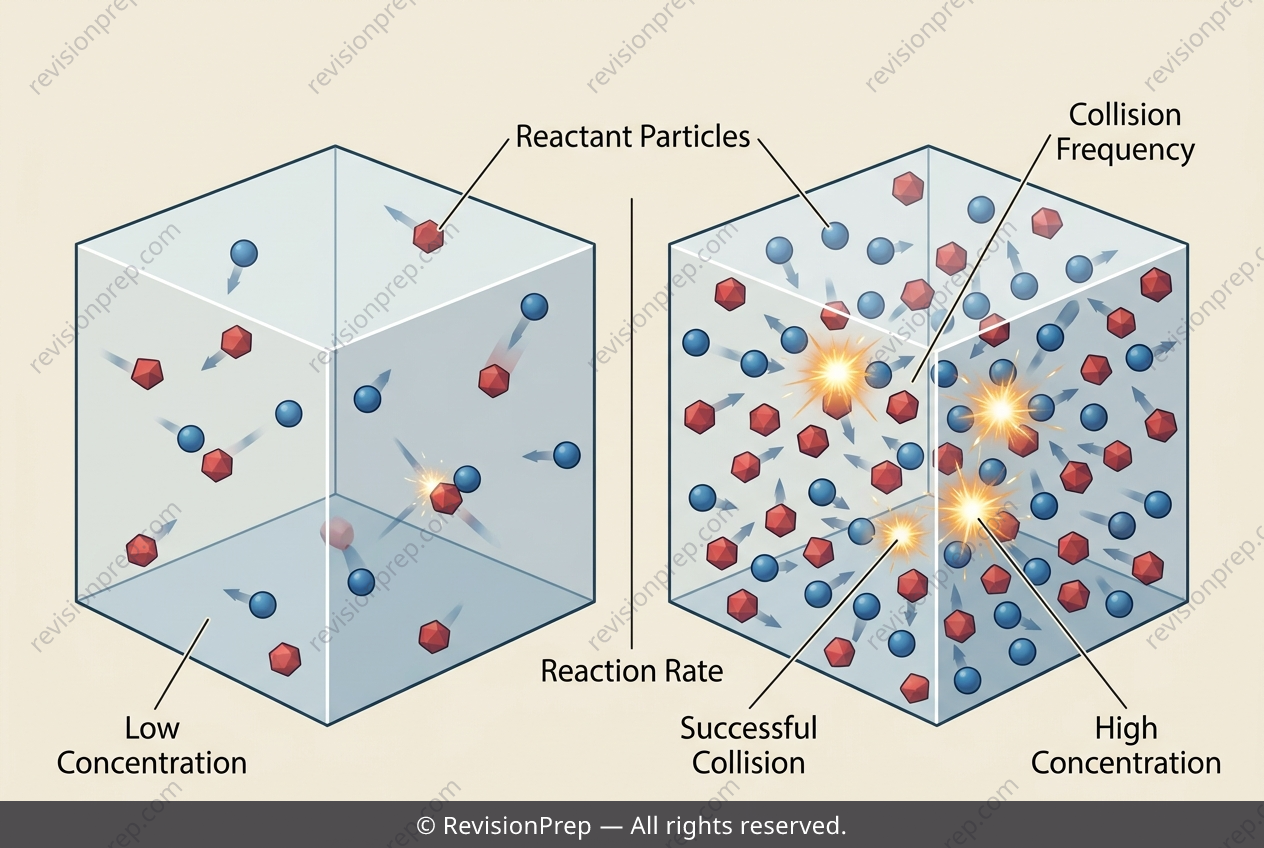
Collision theory is the foundation for understanding why chemical reactions happen at different speeds. At its core, the theory states that for a reaction to occur, reactant particles must collide with sufficient energy and the correct orientation. This simple idea explains everything from why food spoils faster in warm climates to why industrial processes carefully control pressure and concentration. In the context of reactivity, the rate of a reaction is directly tied to how often and how effectively particles meet. When you increase the concentration of a reactant, you are packing more particles into the same volume. This does not change their average kinetic energy or lower the activation energy barrier—those are affected by temperature and catalysts, respectively. Instead, higher concentration simply increases the number of particles per unit volume, which leads to a higher frequency of collisions per second. More collisions mean more chances for successful reactions, and since the rate is proportional to collision frequency, the reaction proceeds faster. This relationship is central to the rate equation, where rate often depends on the concentration of reactants raised to a power, reflecting how collision probability scales with particle density.
Start practising IB questions today
150,000+ IB-styled questions, criteria-mapped and instantly accessible.