
Chemistry: Why Ethyne Reacts Slower Than Ethene
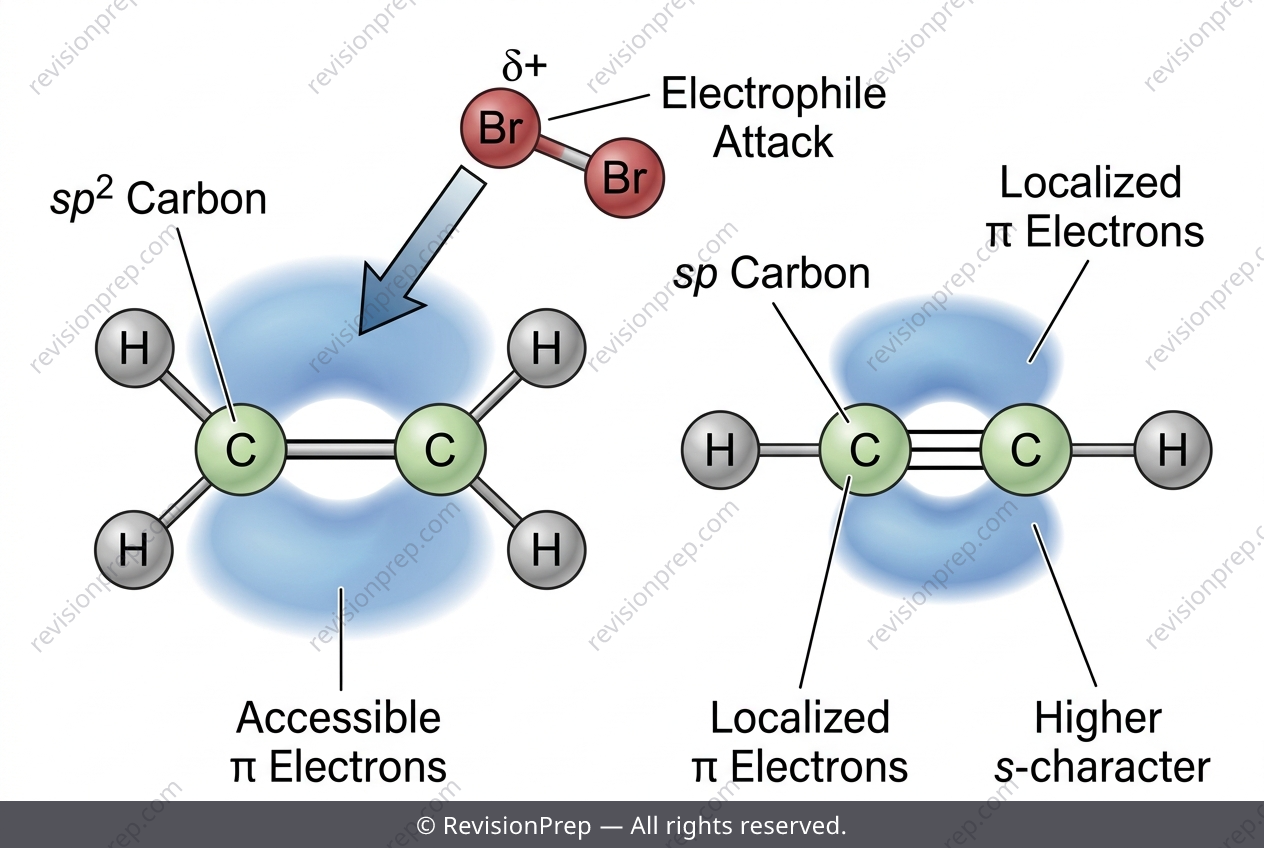
In electrophilic addition, the availability of π electrons is not simply a matter of how many there are—it is governed by the hybridisation of the carbon atoms holding them. For hydrocarbons, ethene (sp²) and ethyne (sp) both offer π electron density to reagents like bromine, yet their reactivity differs markedly. The key lies in how the s-character of the hybrid orbitals shapes the electron cloud around the carbon skeleton. The 50% s-character of sp hybridised carbons in ethyne pulls electron density closer to the nucleus, making these carbons more electronegative than the sp² carbons of ethene (33% s-character). This withdrawal reduces the polarisability and effective nucleophilicity of the π system in ethyne, even though it contains two π bonds. Additionally, the shorter, stronger C≡C triple bond raises the activation energy needed to break the first π bond. Together, these factors explain why ethyne’s extra π electrons are less accessible to an electrophile, slowing its reaction with bromine relative to ethene. Understanding this interplay between hybridisation, electron density, and bond strength is central to predicting addition reaction rates.
Start practising IB questions today
150,000+ IB-styled questions, criteria-mapped and instantly accessible.