
Chemistry: Why Graphene Conducts Electricity So Well
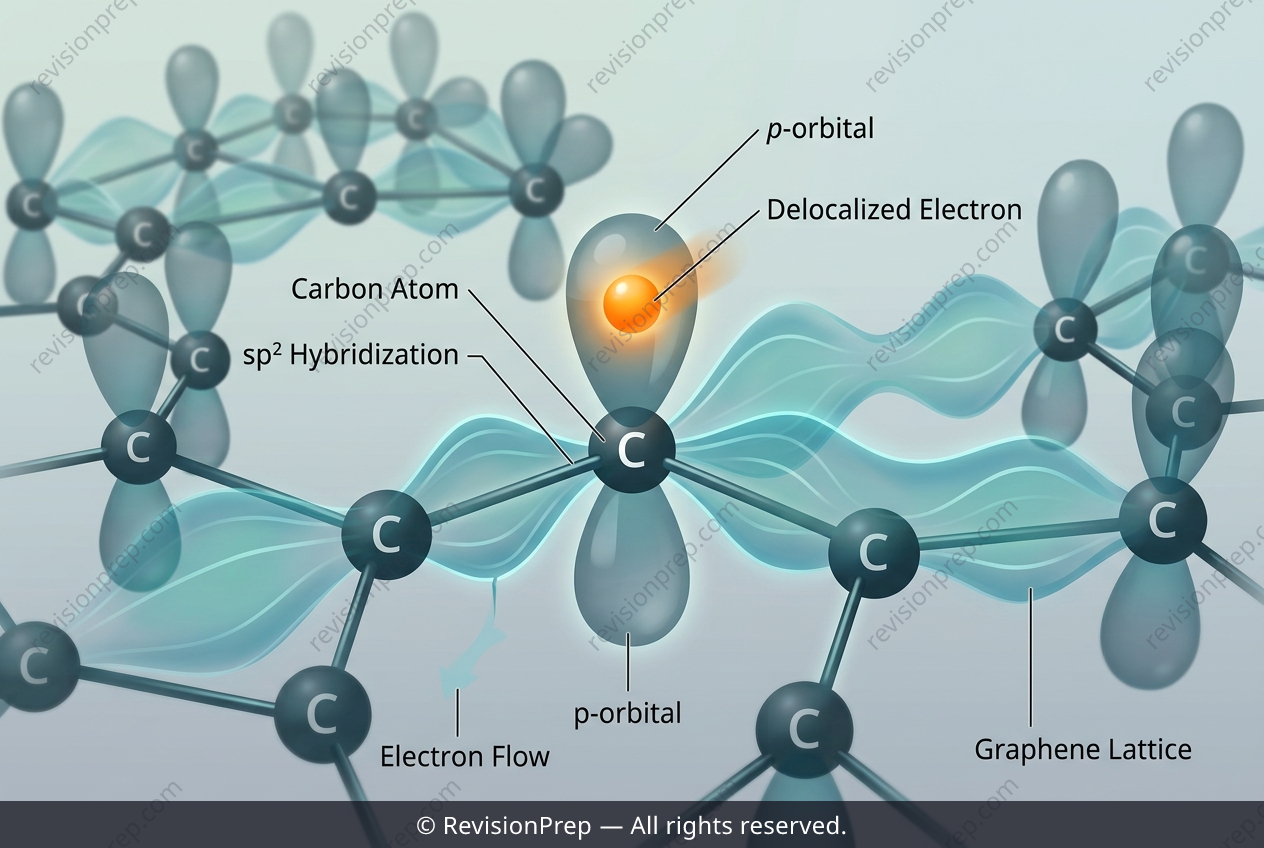
Graphene is a single layer of carbon atoms arranged in a hexagonal lattice, and its remarkable electrical conductivity stems from a subtle feature of its bonding. In this structure, each carbon atom undergoes sp² hybridization, forming three strong sigma bonds with its neighbours. Crucially, this leaves one unhybridized p-orbital per atom, oriented perpendicular to the planar sheet. The key to graphene’s conductivity lies in how these p-orbitals interact. Rather than forming isolated, localised bonds, the p-orbitals overlap sideways across the entire lattice, allowing their electrons to become fully delocalized. This creates a continuous “sea” of mobile electrons that can move freely along the sheet, effectively forming a conducting band. Because each carbon contributes exactly one such electron, the band is partially filled, meaning there is no energy gap for electrons to jump—they can flow with minimal resistance. This delocalization is what distinguishes graphene from materials with discrete single and double bonds, where electron movement would require breaking or hopping between localised states. Understanding this model of extended covalent structures explains not only graphene’s conductivity but also the fundamental difference between localised and delocalized bonding in materials.
Start practising IB questions today
150,000+ IB-styled questions, criteria-mapped and instantly accessible.