
Chemistry: Why Harder Does Not Always Mean Stronger
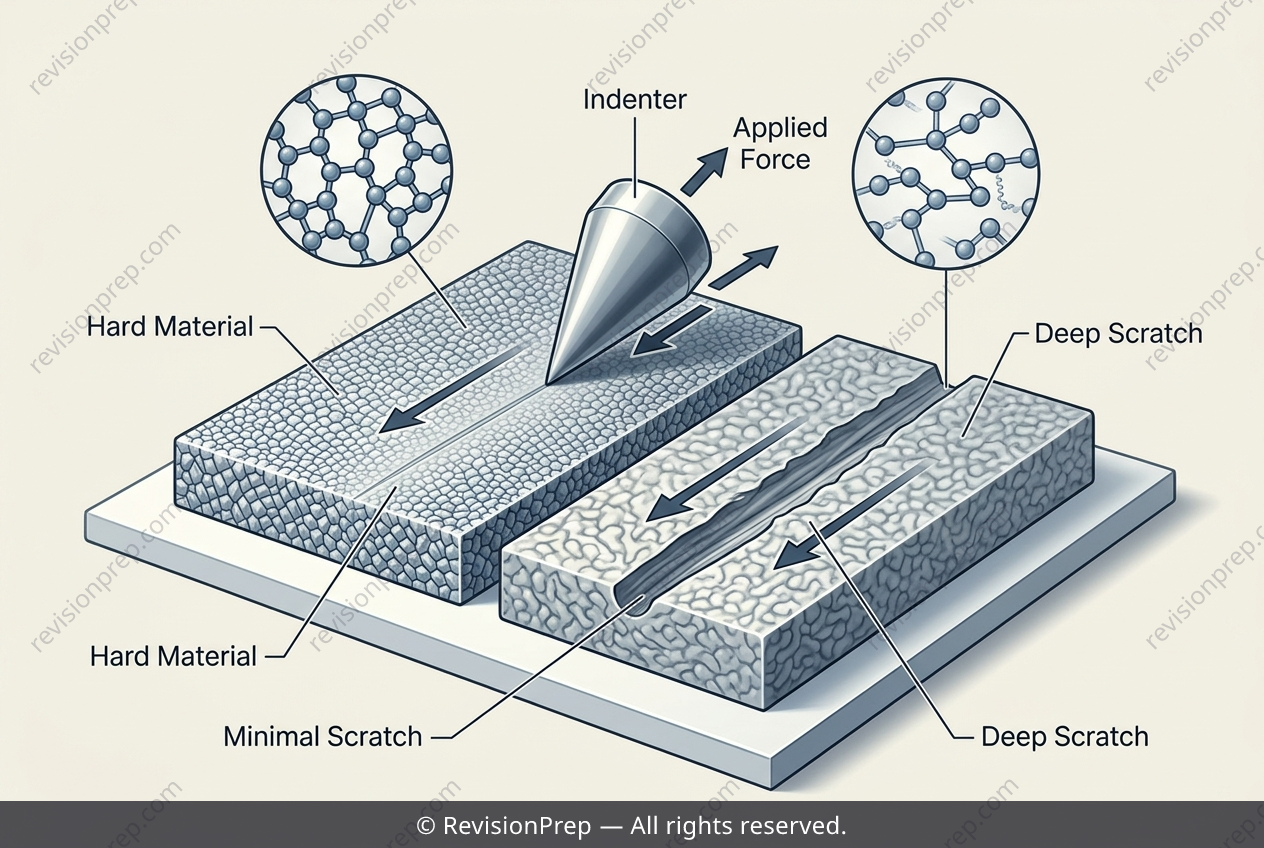
Hardness is often conflated with strength or toughness, but in materials science, it is a distinct mechanical property that describes resistance to localized surface deformation—most practically, scratch resistance. The Mohs scale, a qualitative ordinal ranking from 1 (talc) to 10 (diamond), does not measure force or energy absorption; it simply compares which material can scratch another. A mineral with a higher Mohs number will scratch any material with a lower number, meaning scratch resistance is a direct, one-way comparative relationship. This distinction matters because real-world applications, like cutting tools, demand surface durability under abrasive wear, not necessarily the ability to withstand bending (Young’s modulus), impact (toughness), or pulling (tensile strength). While those properties often correlate with bonding strength—for instance, strong covalent or ionic networks in ceramics—they are governed by different structural responses. A material’s Mohs rating isolates the surface’s resistance to ploughing and fracture at a microscopic scale, independent of bulk elasticity or ductility. Thus, comparing two ceramics on the Mohs scale alone tells you only about their relative scratch resistance, not their overall mechanical performance. Understanding this separation prevents the common error of assuming a harder material is automatically stronger, tougher, or stiffer in every sense.
Start practising IB questions today
150,000+ IB-styled questions, criteria-mapped and instantly accessible.