
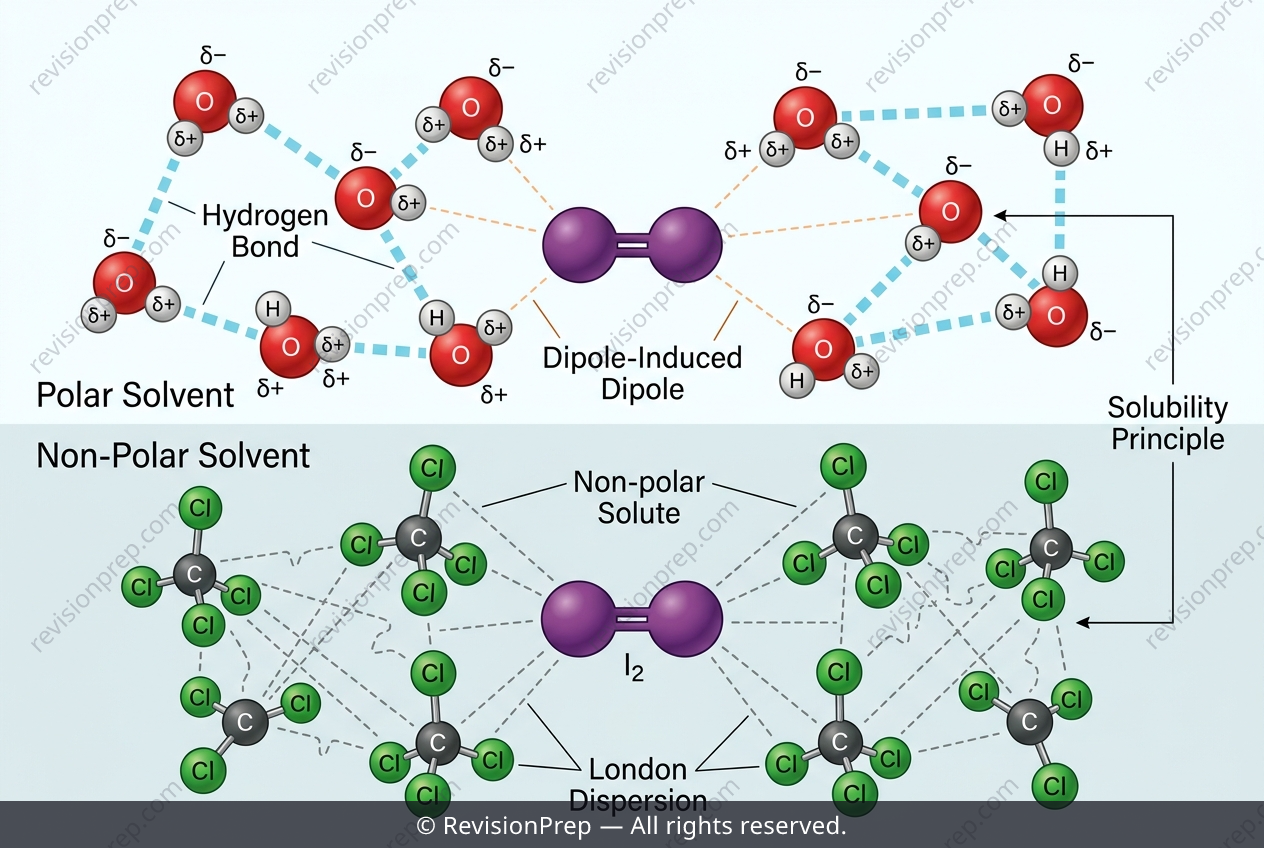
Chemistry: Why Iodine Dissolves in CCl₄, Not Water
Intermolecular forces dictate how molecules interact, and nowhere is their power more visible than in the everyday mystery of solubility. The question of why iodine (I₂) dissolves so poorly in water yet so readily in carbon tetrachloride (CCl₄) is a perfect lens for understanding the balance between solute–solvent attraction and the energy cost of breaking existing interactions. At its heart, this topic hinges on the principle of “like dissolves like.” While a polar solvent like water can induce a temporary dipole in a non-polar molecule, the real story is more nuanced. The key lies in comparing the types and strengths of forces involved. Water molecules are locked together by strong hydrogen bonds, which require significant energy to break, while the only interactions formed with I₂ are weak London dispersion forces. In contrast, CCl₄, despite having polar C–Cl bonds (Δχ = 0.61), is non-polar overall because its tetrahedral geometry cancels the individual bond dipoles—their vector sum equals zero. This leaves CCl₄ held together solely by London dispersion forces, the very same type present in I₂. Consequently, dissolving I₂ in CCl₄ replaces comparable-strength interactions, making the process energetically favourable, whereas mixing with water is not.
Start practising IB questions today
150,000+ IB-styled questions, criteria-mapped and instantly accessible.