
Chemistry: Why Ionic Formulas Must Balance Charges
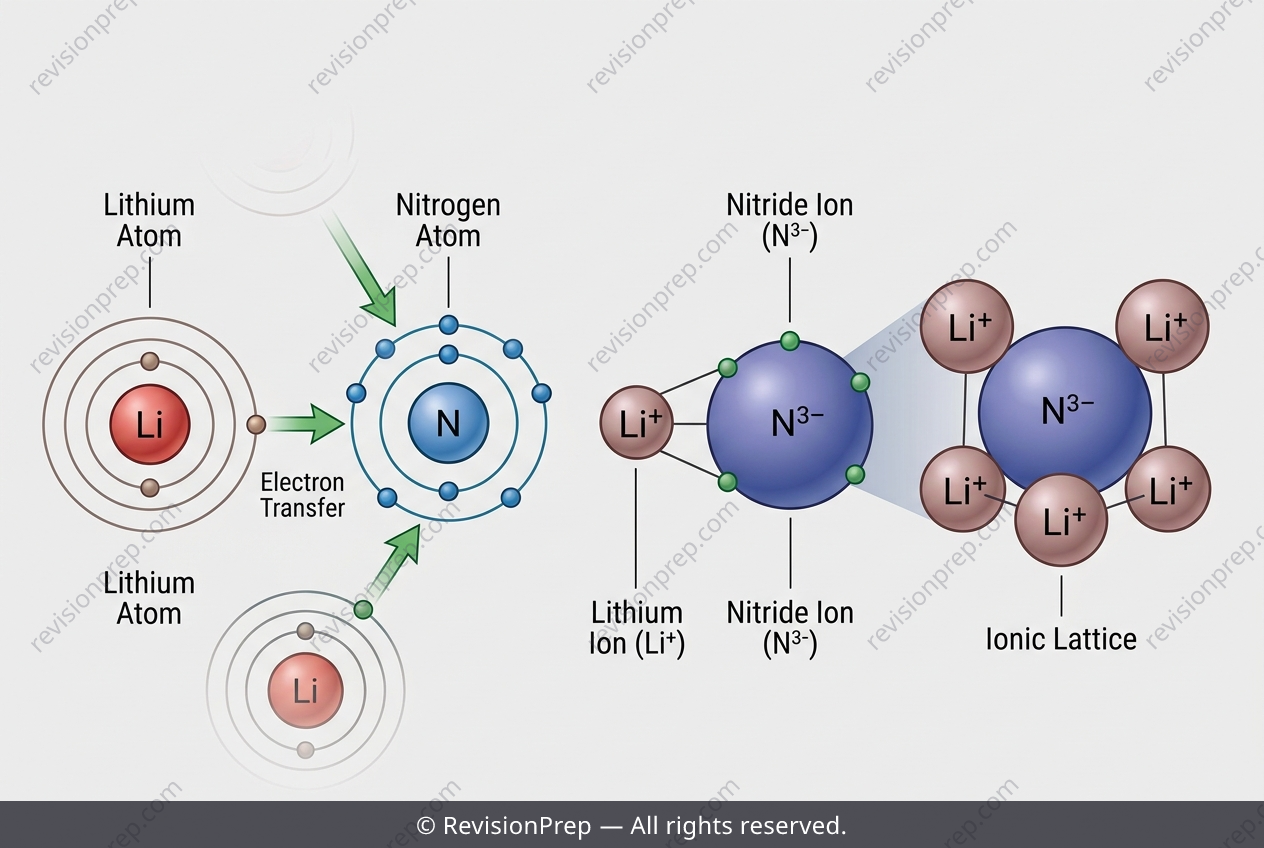
Ionic compounds are held together by the electrostatic attraction between oppositely charged ions, but writing their formulas is far more than a matter of pairing symbols. The core rule is charge balance: the total positive charge must exactly equal the total negative charge, so the compound as a whole is electrically neutral. This principle governs the empirical formula, which expresses the simplest whole-number ratio of ions in the crystal lattice. In lithium nitride, lithium forms a +1 cation (Li⁺) while nitrogen forms a −3 anion (N³⁻). Because a single Li⁺ cannot offset a single N³⁻, the ratio must be adjusted. Three Li⁺ ions contribute a total of +3, which perfectly balances the −3 from one N³⁻ ion. This yields the simplest ratio of three lithium ions to one nitride ion. Understanding this balancing act is essential not only for predicting formulas but also for interpreting real-world materials—like solid-state battery electrolytes—where stoichiometry directly influences ionic conductivity and structural stability. By mastering charge balance, you can move confidently between ion charges and the correct empirical formula for any ionic compound.
Start practising IB questions today
150,000+ IB-styled questions, criteria-mapped and instantly accessible.