
Chemistry: Why Kc Stays Fixed Despite a Shift
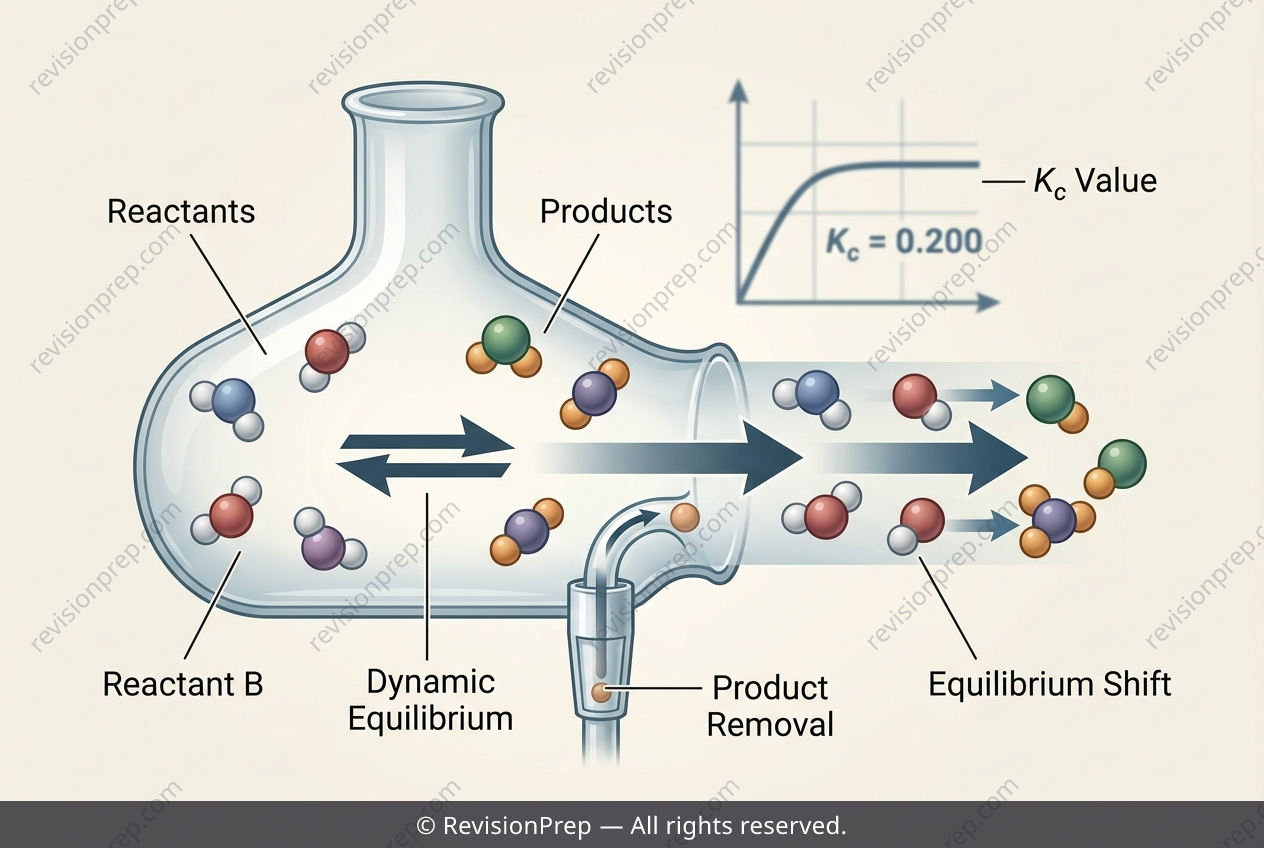
Le Chatelier’s Principle is the compass for predicting how a chemical system at equilibrium responds to disturbance—whether you add a reactant, remove a product, or change pressure. At its heart lies a simple idea: the system will shift to counteract the change, seeking to re‑establish balance. But this principle only tells you which way the equilibrium moves; it says nothing about how far or whether the balance point itself changes. That second question is answered by the equilibrium constant, Kc, a fixed value for a given reaction at a given temperature. In esterification, the reversible reaction between a carboxylic acid and an alcohol produces an ester and water. Here, adding concentrated sulfuric acid to the equilibrium mixture does more than just catalyse the reaction—it also acts as a dehydrating agent, removing water as it forms. By Le Chatelier’s logic, pulling a product out of the mixture shifts the equilibrium to the right, producing more ester. Crucially, Kc remains untouched: it depends solely on temperature, not on concentrations or catalysts. So while the position of equilibrium changes, the ratio of products to reactants at equilibrium stays locked to the same constant—until you change the heat.
Start practising IB questions today
150,000+ IB-styled questions, criteria-mapped and instantly accessible.