
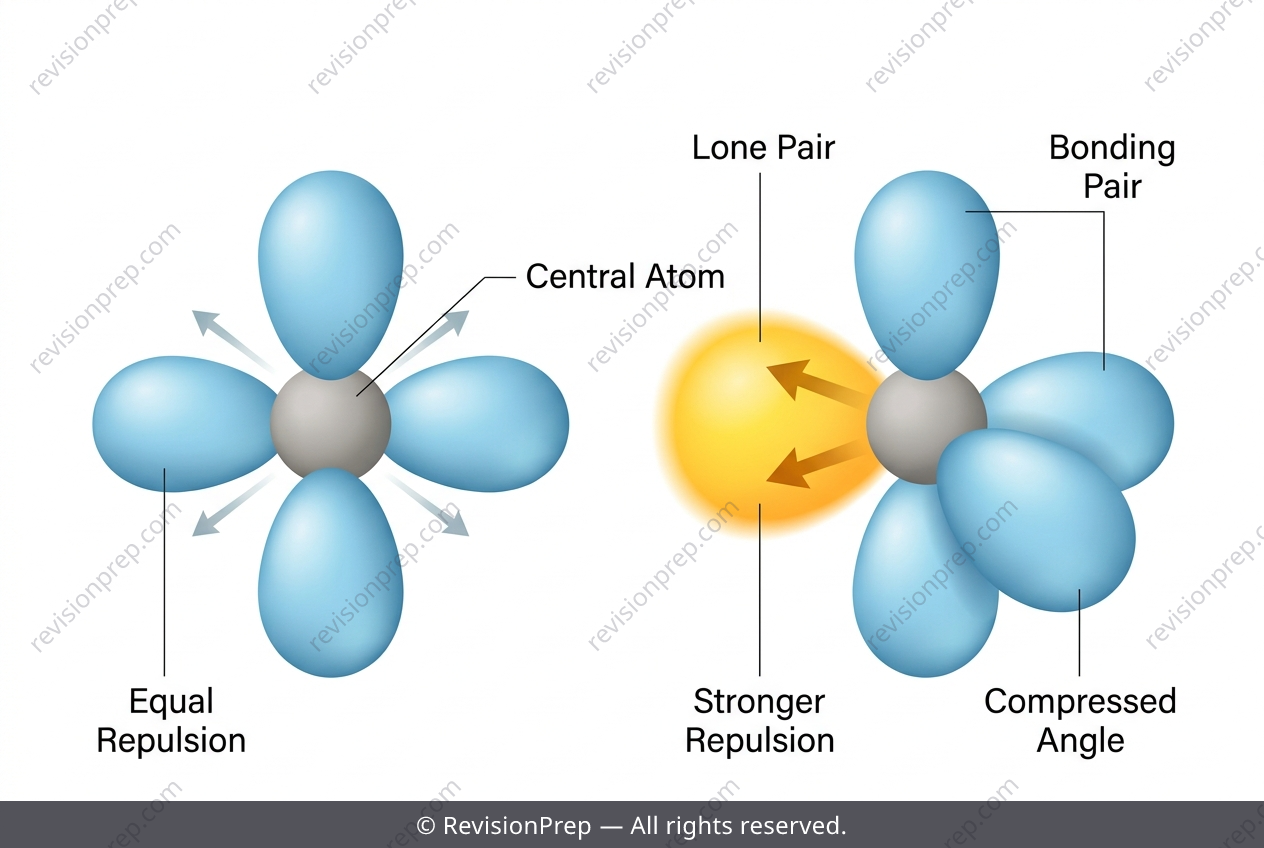
Chemistry: Why Lone Pairs Bend Molecular Shapes
VSEPR theory is the predictive framework chemists use to translate a molecule’s two-dimensional Lewis structure into its three-dimensional shape. At its heart lies a simple premise: electron domains—whether they are bonding pairs or lone pairs—arrange themselves as far apart as possible to minimize electrostatic repulsion. This geometry, in turn, dictates bond angles, polarity, and how the molecule interacts with others, making VSEPR a cornerstone for understanding everything from reactivity to biological function. The theory’s power emerges when comparing molecules with identical electron-domain counts but different shapes. Both methane and ammonia feature four electron domains around their central atoms, which would ideally produce a perfect tetrahedral angle of 109.5°. However, the key distinction lies in the type of domain. A lone pair occupies more space and exerts a stronger repulsive force than a bonding pair, because it is held solely by one nucleus and is not “shared” with another atom. This lone pair–bonding pair repulsion compresses the angles between the remaining bonding pairs, distorting the ideal geometry. Thus, while the electron-domain arrangement remains tetrahedral, the observed bond angles shrink—a direct consequence of the hierarchy of repulsions: lone pair–lone pair > lone pair–bonding pair > bonding pair–bonding pair. Recognizing this ordering allows students to predict not just shapes, but the subtle deviations from ideal angles that define real molecules.
Start practising IB questions today
150,000+ IB-styled questions, criteria-mapped and instantly accessible.