
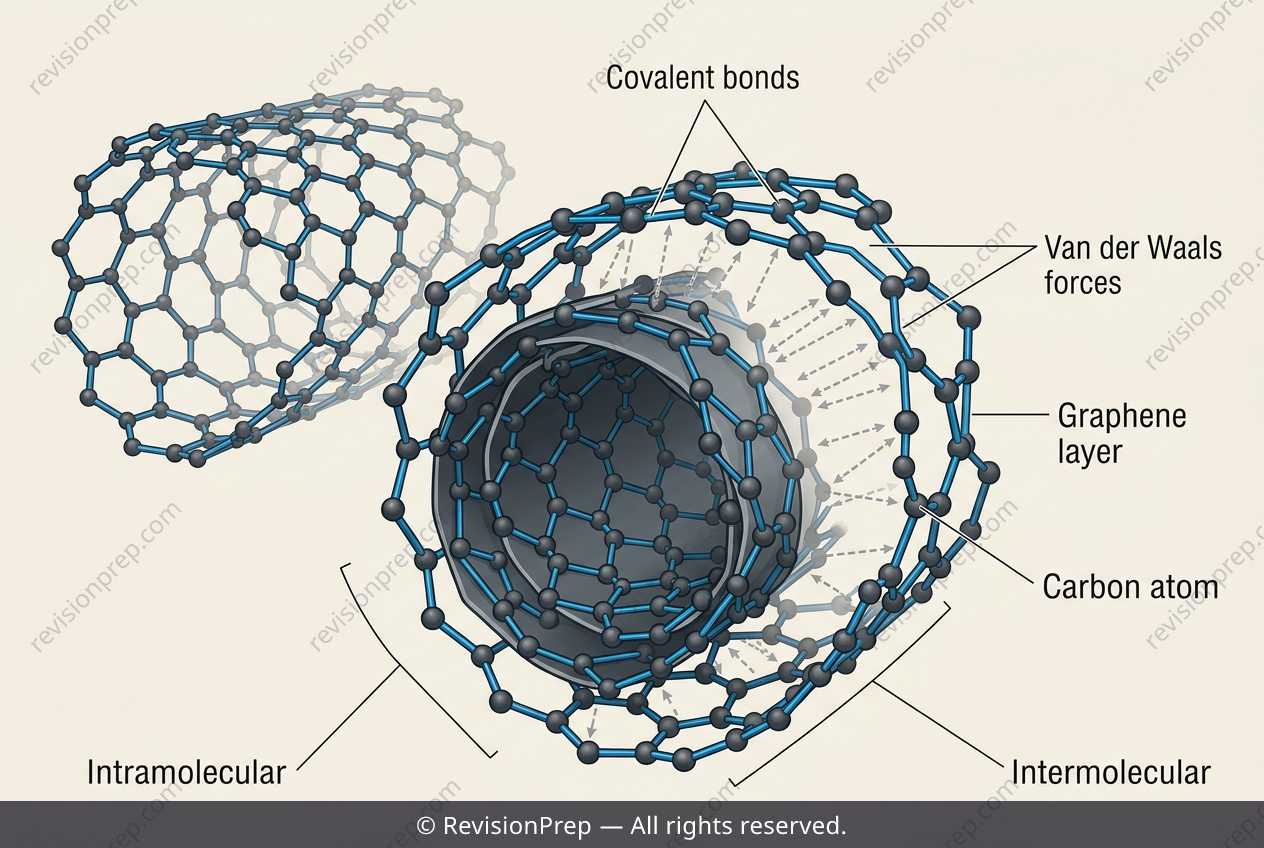
Chemistry: Why Nanotube Layers Slide but Don't Break
Carbon nanotubes are remarkable structures built from pure carbon, and they offer a perfect lens for understanding how bonding dictates material properties. At the heart of this topic is the distinction between the strong, directional covalent bonds that form within a single layer of atoms, and the much weaker, non-directional intermolecular forces that can act between separate layers. In a single-walled carbon nanotube (SWCNT), every carbon atom is sp²-hybridised, forming a continuous covalent network of sigma and pi bonds that make up the cylindrical wall. This is the same bonding found in a flat graphene sheet. When you move to a multi-walled carbon nanotube (MWCNT), you are essentially stacking several of these covalent cylinders concentrically. Crucially, no new covalent bonds form between these separate layers. Instead, the layers are held together by van der Waals forces—weak electrostatic attractions arising from temporary fluctuations in electron distribution. These forces are what allow the concentric tubes to slide and interact, giving MWCNTs their unique mechanical and electrical behaviour. Understanding this hierarchy—strong intramolecular bonds versus weak intermolecular forces—is essential for predicting how any carbon allotrope will behave.
Start practising IB questions today
150,000+ IB-styled questions, criteria-mapped and instantly accessible.