
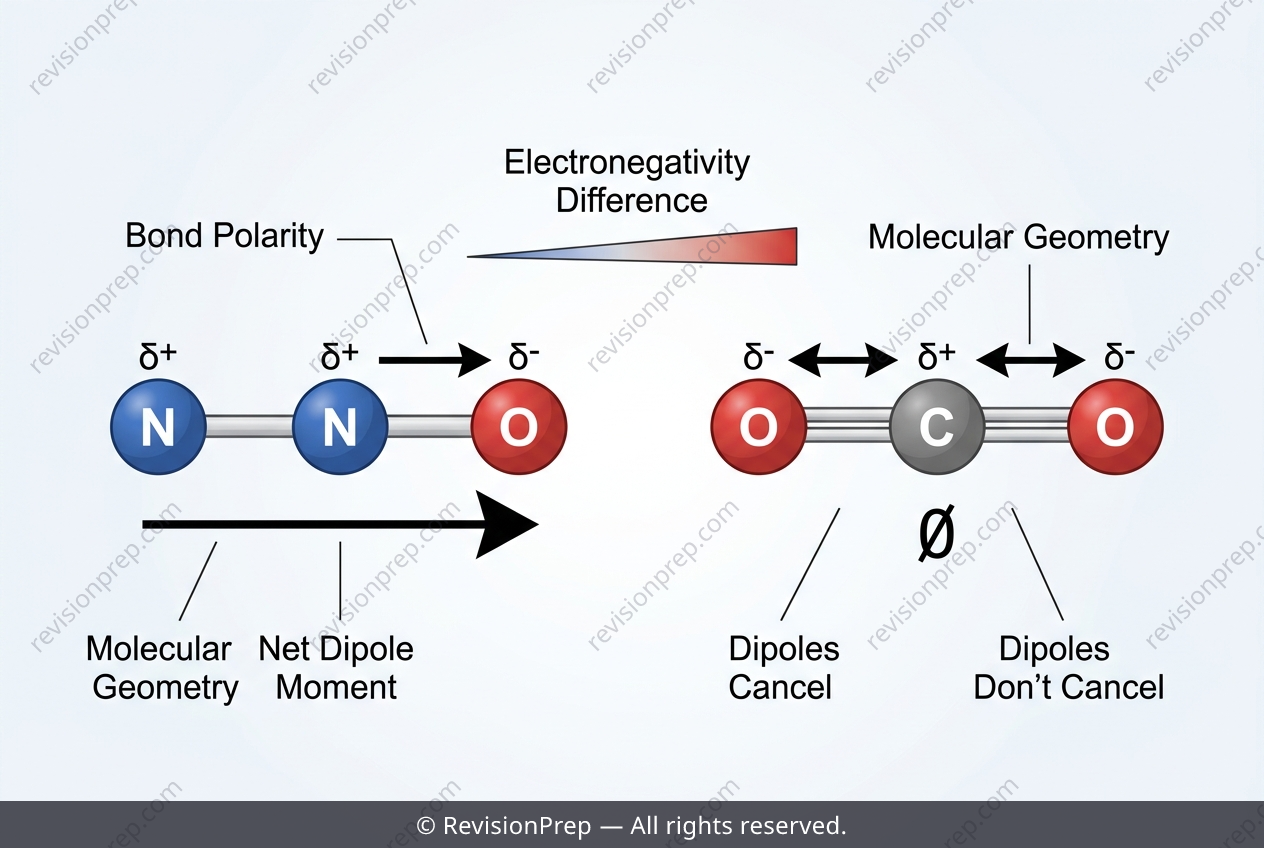
Chemistry: Why N₂O Is Polar but CO₂ Is Not
Molecular polarity is the unsung hero of atmospheric chemistry—it determines how a molecule interacts with radiation, other molecules, and ultimately its behaviour as a greenhouse gas. At its heart, polarity emerges from two ingredients: the electronegativity difference (ΔEN) between bonded atoms, which sets the size and direction of each bond dipole, and the three-dimensional geometry that dictates whether those individual dipoles add up or cancel out. For a linear molecule like dinitrogen monoxide (N₂O), the story unfolds in two steps. First, you assess each bond independently: a N–N bond has ΔEN = 0, meaning its bond dipole vector has zero magnitude—it is purely non-polar covalent. In contrast, the N–O bond shows a small but real ΔEN, creating a non-zero dipole that points from the less electronegative nitrogen toward the more electronegative oxygen. Second, you perform vector addition of these bond dipoles. Since one vector is zero and the other is not, the resultant molecular dipole can never vanish—it simply inherits the direction and magnitude of the N–O bond. This is precisely why N₂O is polar, whereas carbon dioxide (CO₂), with two equal and opposite C–O dipoles, achieves perfect cancellation. The key relationship? Polarity is not just about bond strength—it is about whether the molecular architecture allows dipoles to align or annihilate.
Start practising IB questions today
150,000+ IB-styled questions, criteria-mapped and instantly accessible.