
Chemistry: Why Oxygen Boils Higher Than Fluorine
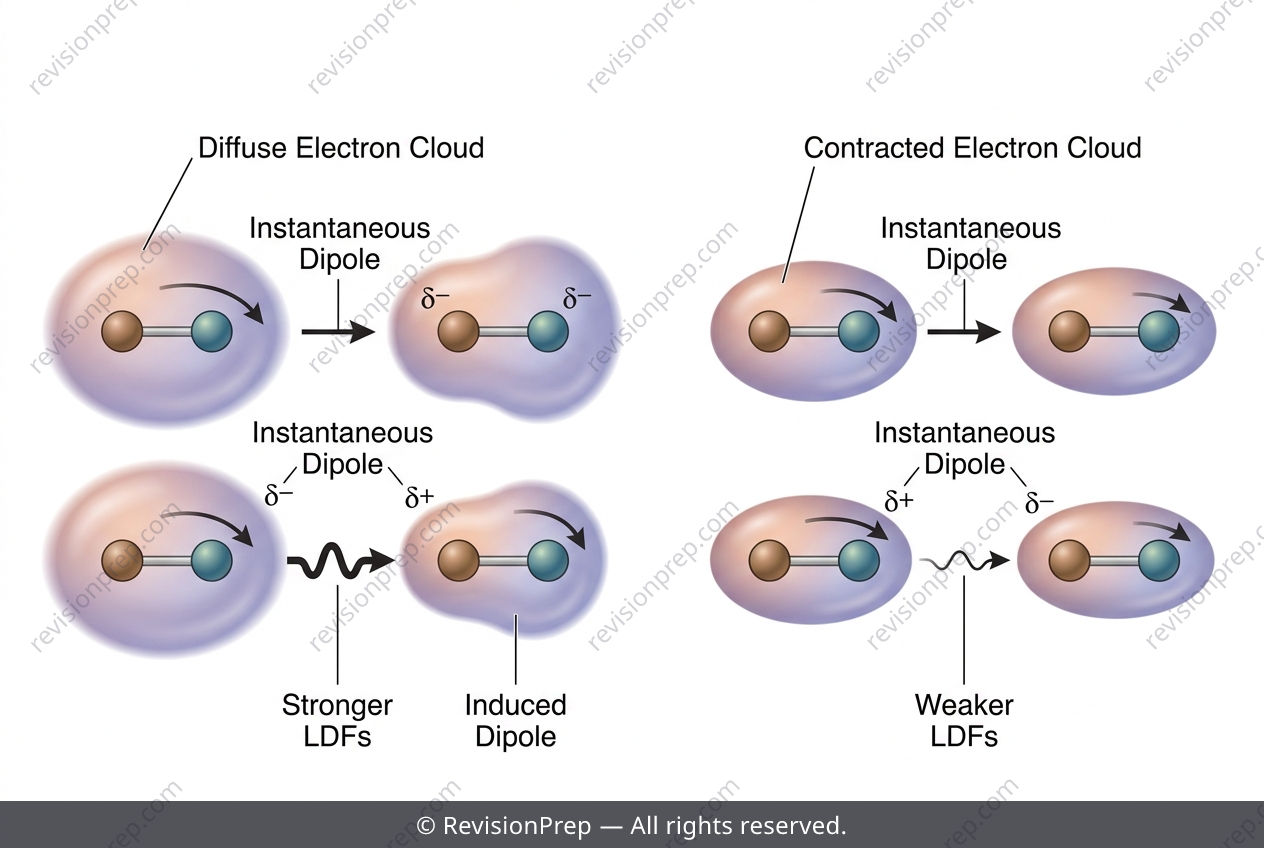
London dispersion forces (LDFs) are the weakest intermolecular attractions, yet they dictate the boiling points of non-polar molecules like nitrogen, fluorine, and oxygen. These forces arise from temporary, instantaneous dipoles caused by fluctuations in electron distribution, and their strength depends on how easily a molecule’s electron cloud can be distorted—a property called polarizability. For students of bonding and structure, understanding why a heavier molecule might boil lower than a lighter one is a classic test of this concept. The key relationship is that LDF strength increases with electron count and with electron cloud diffuseness. While fluorine (F₂) has more electrons than oxygen (O₂), fluorine’s nucleus exerts a strong pull that contracts its electron cloud, making it less polarizable. Oxygen’s electrons, held less tightly, form a more diffuse cloud that distorts more readily, generating stronger temporary dipoles. Thus, despite its lower molar mass, O₂ experiences stronger LDFs and a higher boiling point than F₂. This illustrates that polarizability—not just electron number—governs dispersion force magnitude.
Start practising IB questions today
150,000+ IB-styled questions, criteria-mapped and instantly accessible.