
Chemistry: Why Pure Metals Conduct Better Than Alloys
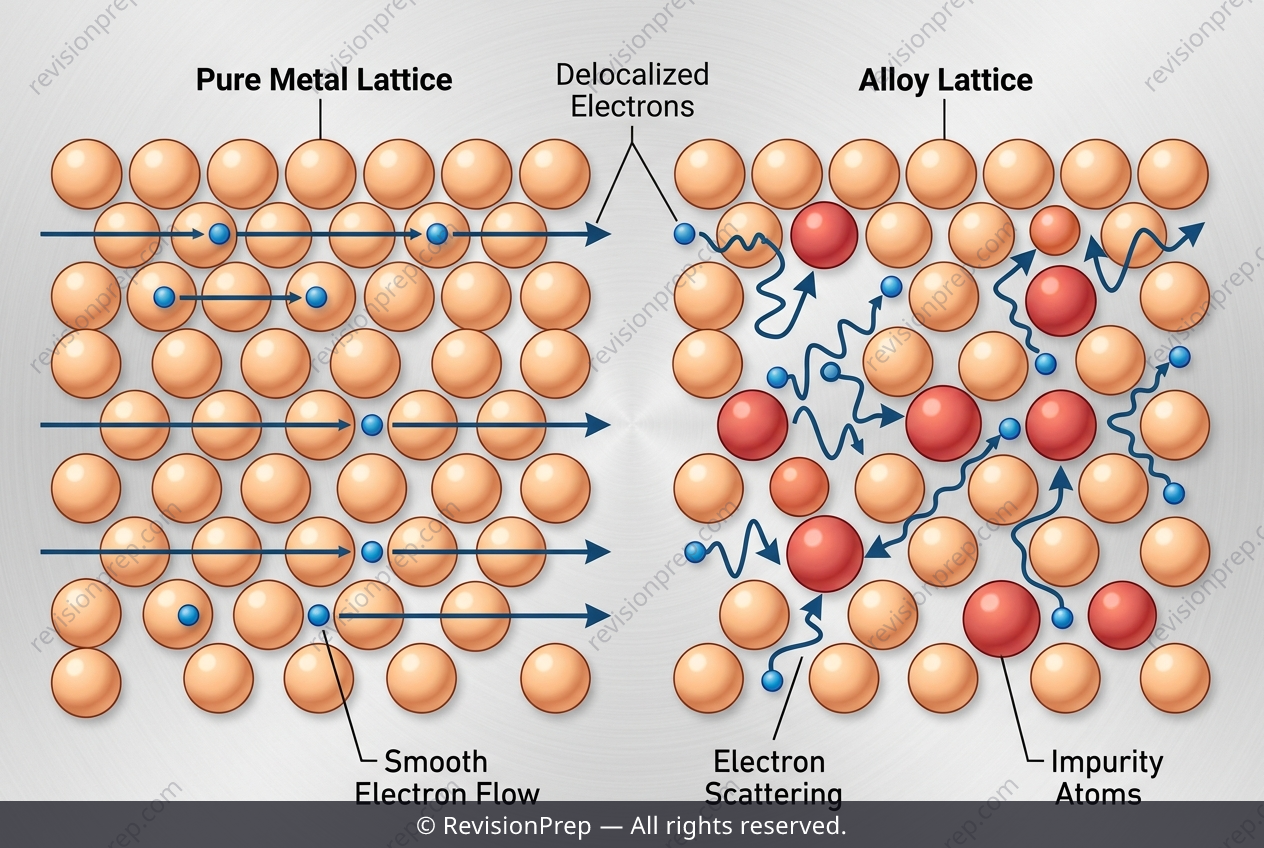
The metallic bonding model paints a picture of positively charged ions fixed in a lattice, bathed in a mobile ‘sea’ of delocalized electrons. This simple image elegantly explains why metals conduct electricity, but it only tells half the story. The real question is why conductivity varies so dramatically between different metallic samples, even when they share the same fundamental bonding type. The answer lies in the physics of electron scattering. Conductivity depends on both the number of free charge carriers (n) and how easily they can move, which is governed by their mean free path and relaxation time (τ). While pure silver offers a near-perfect periodic lattice for electrons to flow through, introducing copper atoms—which are significantly smaller (128 pm vs. 165 pm)—distorts this regularity. This lattice strain acts as a series of obstacles, increasing the frequency of electron collisions. Since both metals contribute roughly one free electron per atom, the carrier density barely changes; the dramatic drop in conductivity for the alloy is instead a direct consequence of this reduced mean free path, a crucial distinction that links atomic structure directly to macroscopic electrical properties.
Start practising IB questions today
150,000+ IB-styled questions, criteria-mapped and instantly accessible.