
Chemistry: Why Triple Bonds Aren't Three Times Stronger
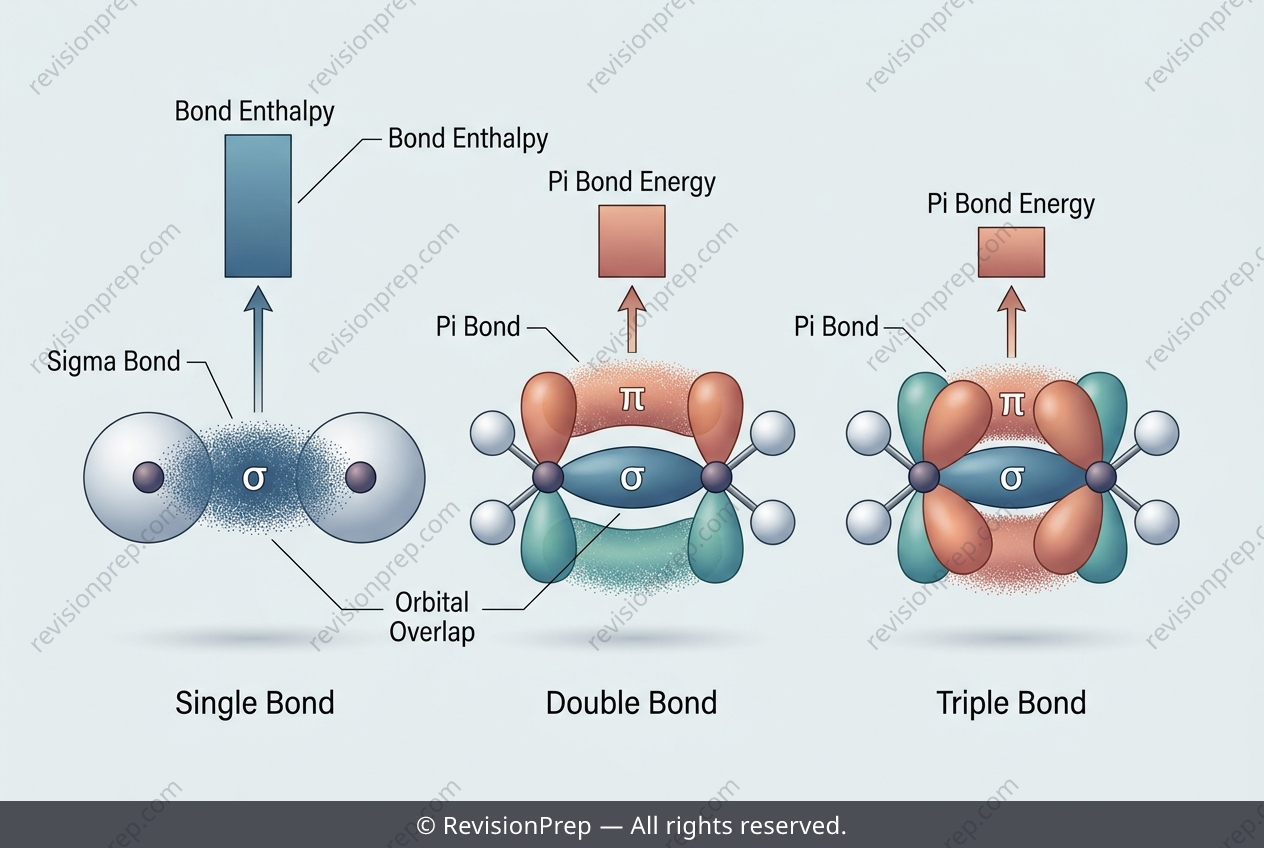
When atoms share electrons, they rarely do so through a single, uniform connection. Instead, the bond between two atoms is a layered structure, built from different types of orbital overlaps that carry distinct energies. The distinction between sigma (σ) and pi (π) bonds is fundamental to explaining not just molecular shape, but also the strength and reactivity of the connections holding a molecule together. Understanding this relationship is crucial because it reveals why bond enthalpy—the energy required to break one mole of a bond—is not simply a linear multiple of the number of shared electron pairs. While a single bond is one sigma bond, a double bond consists of one sigma and one pi bond, and a triple bond contains one sigma and two pi bonds. Crucially, pi bonds arise from the side-on overlap of p-orbitals, which is significantly weaker than the head-on overlap that forms a sigma bond. Consequently, adding pi bonds increases the total bond enthalpy, but each added pi bond contributes less energy than the sigma bond beneath it. This is why comparing the enthalpy of a single bond to a triple bond is not a simple matter of multiplication; the ratio observed reflects the inherent energetic hierarchy between sigma and pi interactions, not an arithmetic rule.
Start practising IB questions today
150,000+ IB-styled questions, criteria-mapped and instantly accessible.