
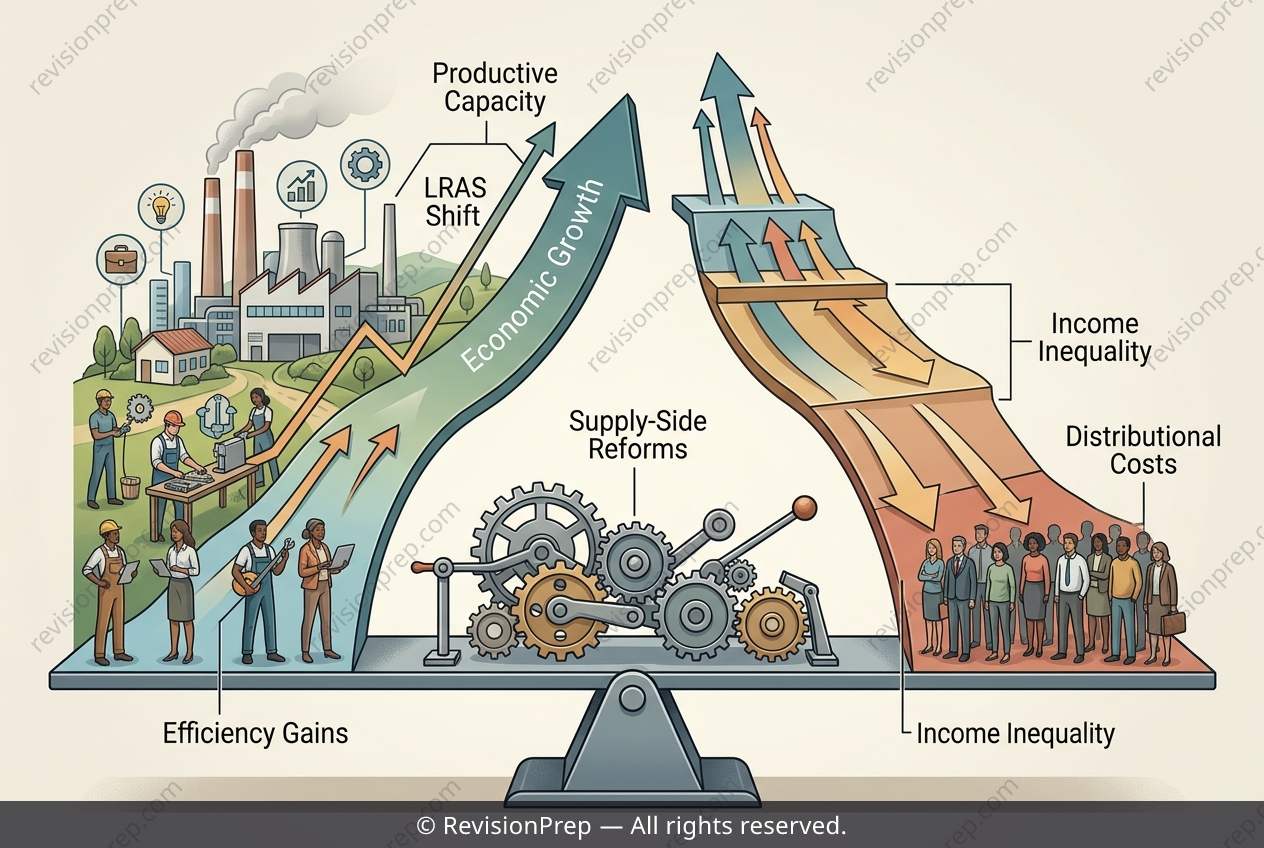
Economics: Can Supply-Side Reforms Deliver Fair Growth?
Supply-side policies aim to expand an economy's productive capacity by improving the quantity and quality of its factors of production, shifting LRAS and SRAS rightward rather than simply stimulating demand. In the AD/AS model, this appears as LRAS₁ moving to LRAS₂ and SRAS₁ to SRAS₂, producing a new equilibrium at (Y₂, P₂) where real GDP is higher and the average price level is lower. The mechanisms matter because they determine whether growth is sustainable. Labour market reforms lower unit labour costs, encouraging firms to hire and invest; deregulation lowers barriers to entry, letting new service-sector firms compete and raise capital investment. Yet supply-side policies carry trade-offs: cheaper youth labour may reduce structural unemployment while worsening income inequality through a two-tier wage system, and an ageing population can limit how far labour supply actually responds. Understanding these connections is essential for evaluating whether such reforms genuinely raise long-run output.
Start practising IB questions today
150,000+ IB-styled questions, criteria-mapped and instantly accessible.