
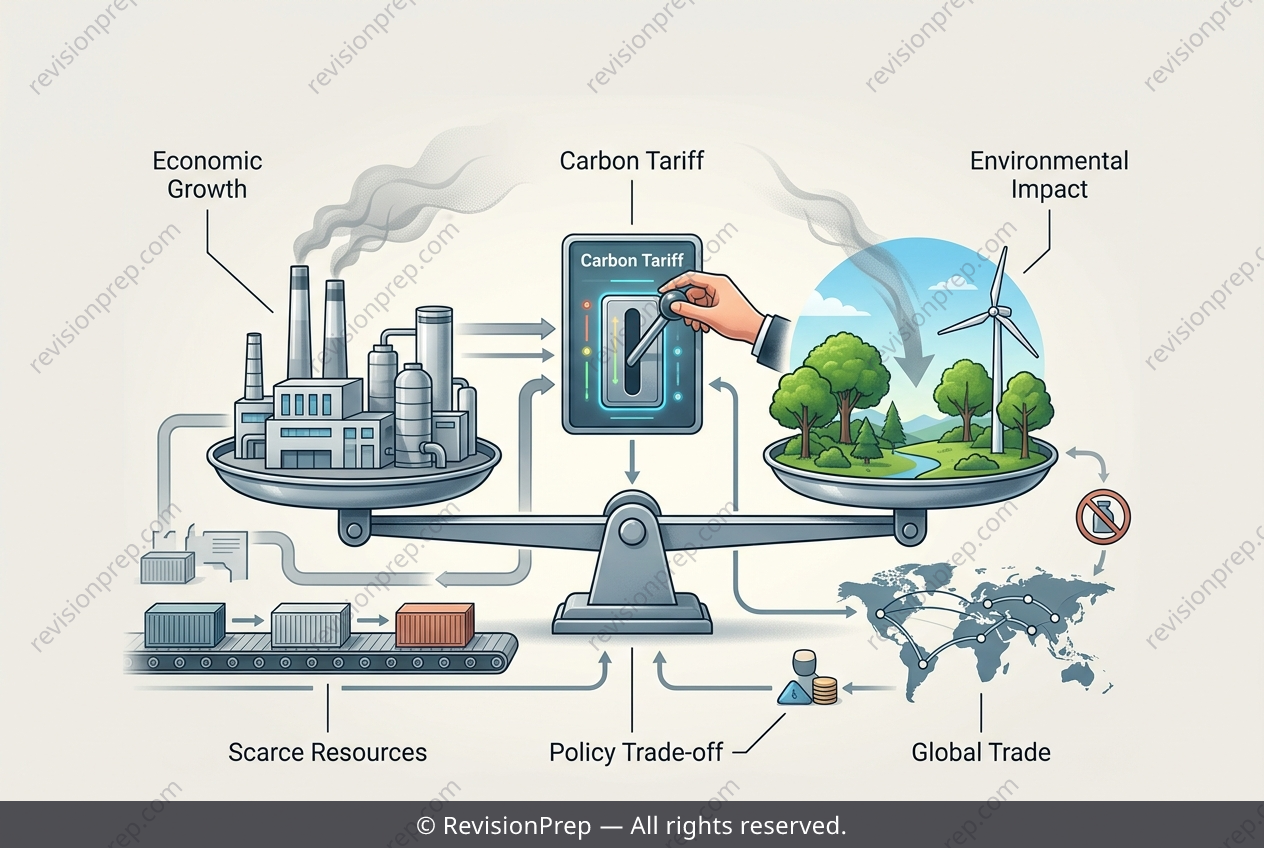
Economics: CBAM — Climate Gains, Economic Costs
Scarcity is the foundational problem of economics: the condition in which unlimited human wants perpetually exceed the finite resources available to satisfy them. For a government, this means every choice—whether to fund healthcare, infrastructure, or environmental protection—involves giving up something else. The EU’s Carbon Border Adjustment Mechanism (CBAM) on imported steel is a perfect lens for this tension, because it forces a trade-off between two scarce goods: the environmental capacity to absorb carbon emissions, and the economic benefit of cheap inputs for manufacturers. The policy works through a simple mechanism: a carbon tariff raises the effective import price from the world price PW to PT = PW + t, shifting the import supply curve leftward. This drives the equilibrium price up and quantity down, shrinking consumer surplus while creating a government tariff revenue rectangle of (PT − PW) × Q2. The opportunity cost of this environmental gain is the foregone benefit of cheaper steel—higher input costs for construction and automotive industries, reduced international competitiveness, and potential job losses. In essence, the EU is allocating its scarce fiscal and political capital toward a cleaner climate, sacrificing immediate economic efficiency for a long-term environmental dividend.
Start practising IB questions today
150,000+ IB-styled questions, criteria-mapped and instantly accessible.