
Economics: Elasticity Decides Who Pays the Tax
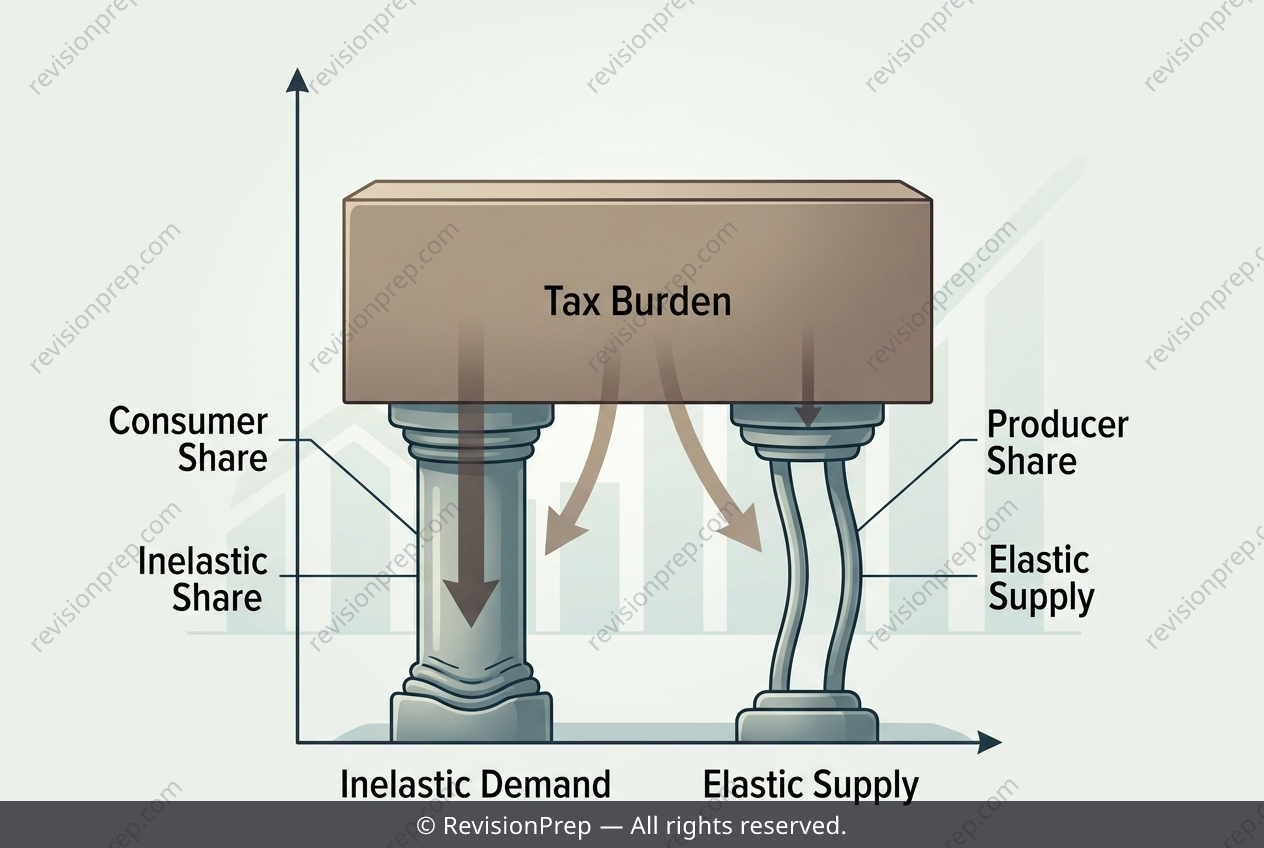
Tax incidence is the study of how the burden of a tax is shared between buyers and sellers—and it is rarely split evenly. In markets for goods like sugar-sweetened beverages, the division depends entirely on how responsive consumers and producers are to price changes, measured by price elasticity of demand (PED) and price elasticity of supply (PES). When a specific tax is imposed, the supply curve shifts vertically upward by the exact amount of the tax, creating a gap between the price consumers pay (Pc) and the price producers receive (Pp). The key relationship is that the more inelastic side of the market bears the larger share of the tax. Here, with PED of -0.4 (inelastic demand) and PES of +1.2 (elastic supply), consumers are relatively unresponsive to price hikes, so they absorb most of the tax through a higher consumer price, while producers, who can easily reduce supply, see only a small drop in their received price. The incidence ratio is approximately PES : |PED|, which reveals the proportional split—without needing to calculate the exact amounts, the logic shows that the less flexible side pays more. Understanding this mechanism explains why taxes on addictive or habitual goods often hit consumers hardest, and why policymakers must consider elasticity before designing public health levies.
Start practising IB questions today
150,000+ IB-styled questions, criteria-mapped and instantly accessible.