
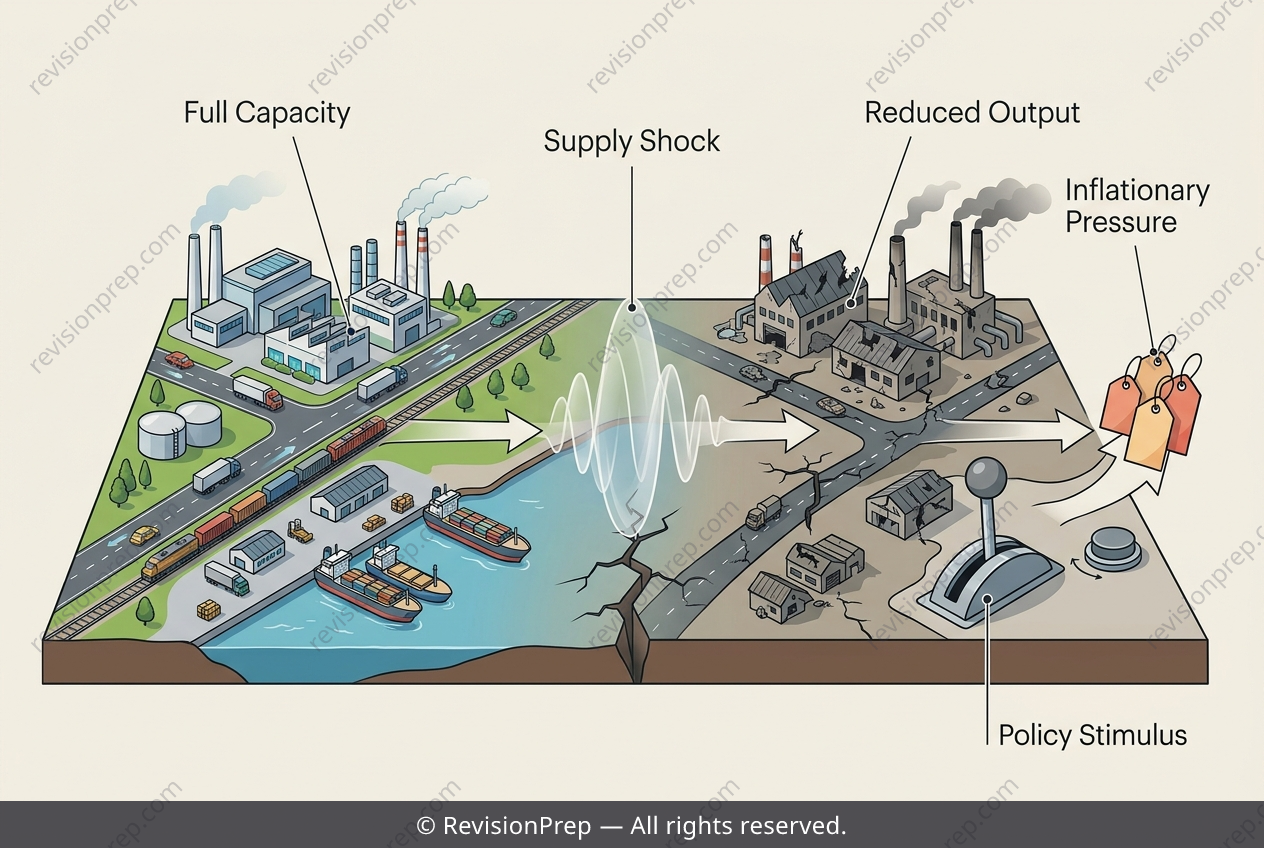
Economics: How Earthquakes Shift LRAS and SRAS Together
A supply-side shock strikes at an economy's ability to produce, not merely its willingness to spend. When a major earthquake destroys factories, roads, and ports, an economy at full employment loses part of its capital stock — the physical backbone of productive capacity. This single event ripples through both time horizons of the AD/AS model simultaneously. The key insight is that the long-run aggregate supply (LRAS) curve shifts left, since potential output Yf falls permanently until capital is rebuilt. The short-run aggregate supply (SRAS) curve also shifts left, because damaged infrastructure raises unit production costs for every firm. With aggregate demand (AD) unchanged, the new equilibrium delivers a higher price level alongside lower real output — the classic stagflation combination of cost-push inflation and recession. Understanding how these curves interact explains why the policy response is far from straightforward: demand-side tools can move AD, but they cannot rebuild the capital stock that determines LRAS.
Start practising IB questions today
150,000+ IB-styled questions, criteria-mapped and instantly accessible.