
Economics: How Elastic Supply Can Grow Total Revenue
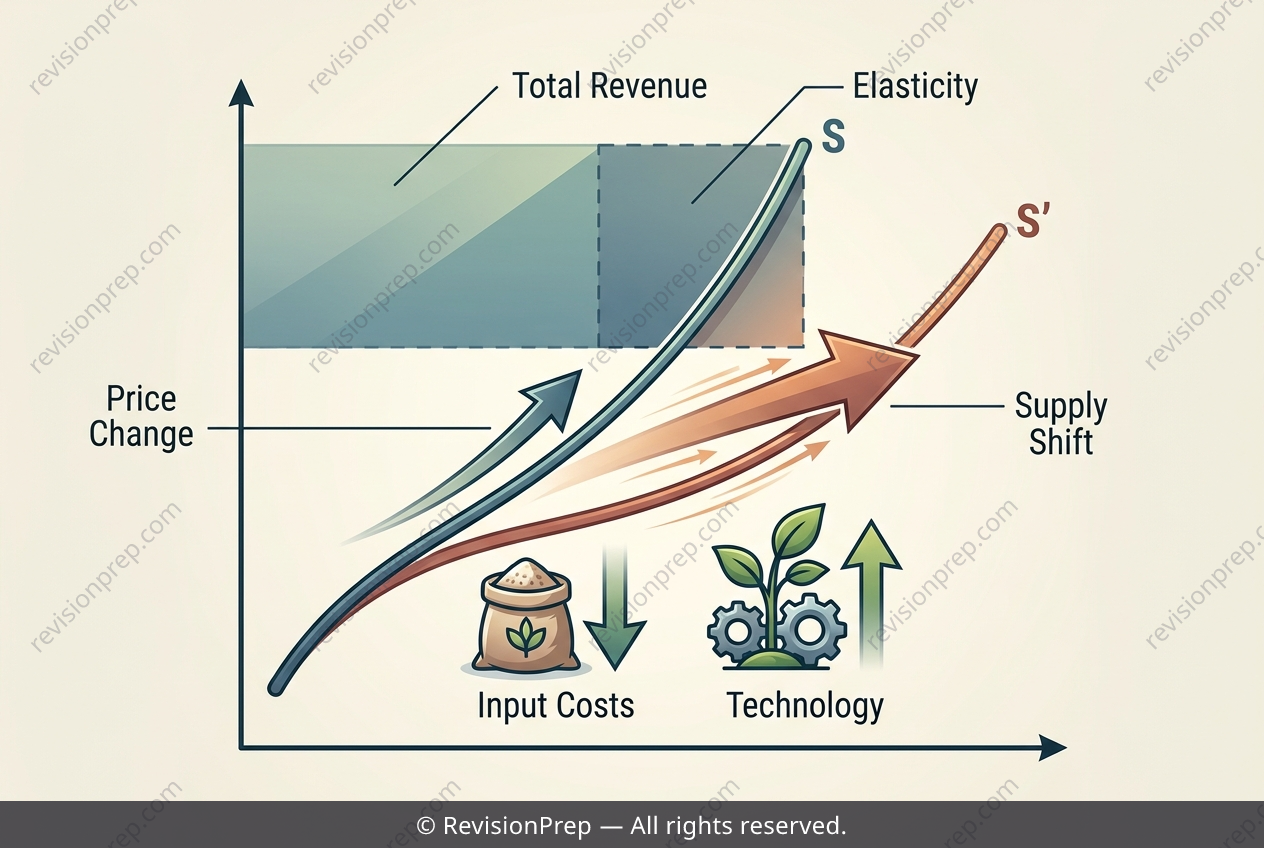
Supply dynamics, elasticity, and total revenue form the backbone of microeconomic analysis—and few markets illustrate their interplay better than Ghana’s cocoa sector. At its core, this topic asks how producers respond to price signals and cost shocks, and whether those responses ultimately grow or shrink a firm’s (or nation’s) earnings. The key relationship is total revenue (TR = P × Q), which hinges on the price elasticity of supply (PES): the percentage change in quantity supplied divided by the percentage change in price. When PES is elastic (>1), quantity responds more than proportionally to a price change; when inelastic (<1), it responds less. In the cocoa case, a government-guaranteed price hike of over 60% triggers a direct, predictable supply response along the existing curve. But that’s only half the story. Simultaneously, falling fertiliser costs and a new high-yield, faster-maturing hybrid tree shift the entire supply curve rightward—meaning more cocoa is supplied at every price, independent of the price change itself. These non-price determinants amplify the quantity effect. In the long run, PES rises above 1, so the combined price-driven and shift-driven quantity increase can outpace the price rise, making the outcome for total revenue unambiguous—provided the guaranteed price holds. Understanding how these forces connect—price elasticity measuring movement along the curve, and supply shifters moving the curve itself—reveals why revenue outcomes are rarely simple.
Start practising IB questions today
150,000+ IB-styled questions, criteria-mapped and instantly accessible.