
Economics: The Trap Behind Predatory Pricing
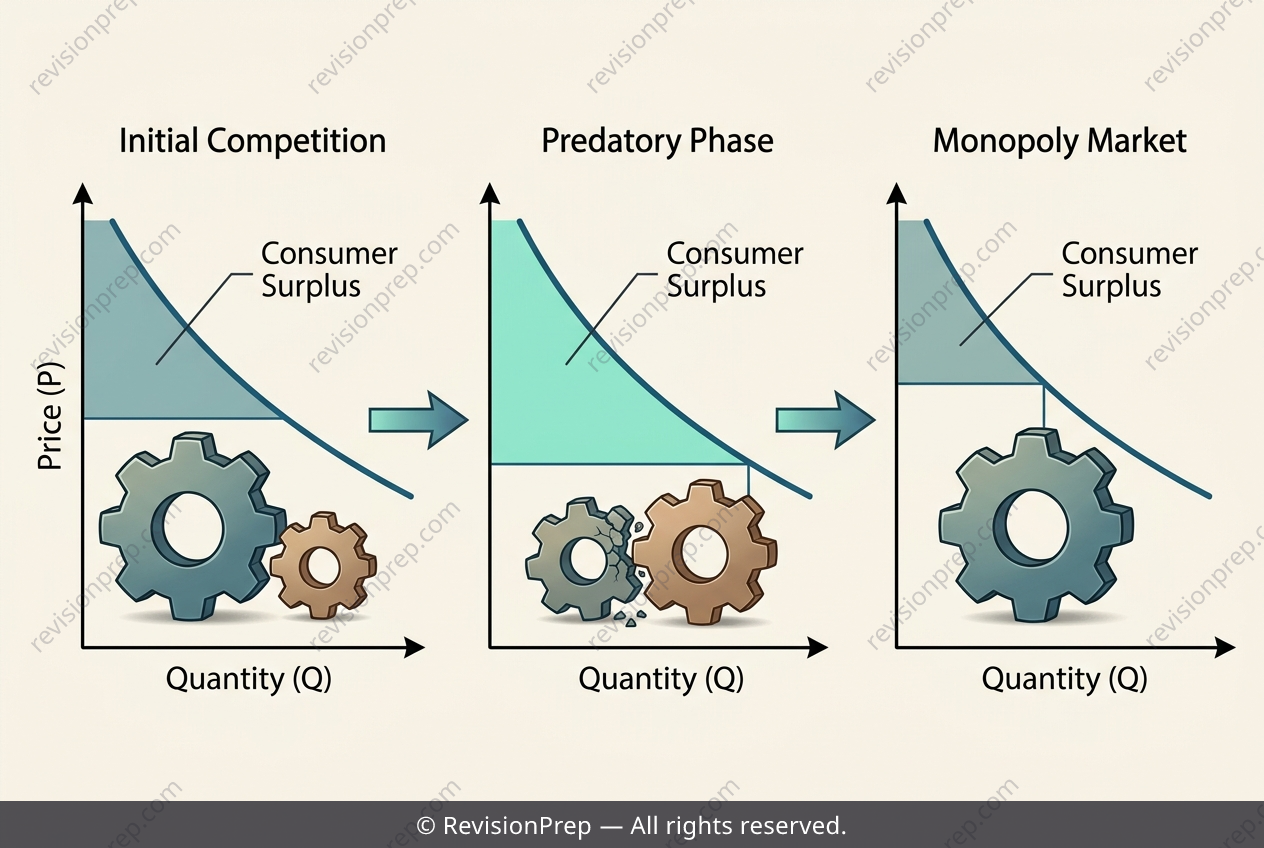
Predatory pricing sits at the sharp edge of market power: a dominant firm temporarily slashes prices below its own costs to eliminate a rival, only to reclaim—and exceed—its original pricing once competition vanishes. In microeconomics, this strategy is assessed through the lens of consumer surplus, the net benefit buyers receive when they pay less than their maximum willingness to pay. For a linear demand curve, that surplus is the triangular area under the demand line and above the market price. When ChipMaster drops its price from USD 50 to USD 30, the quantity demanded expands, and the consumer surplus triangle grows—a short-term windfall for buyers who enjoy cheaper semiconductors. Yet the story does not end with the price cut. The very mechanism that creates this temporary gain—driving NanoTech out—sets the stage for a monopoly. Once the rival exits, ChipMaster can raise prices above the original USD 50, shrinking consumer surplus below its pre-predatory level. The demand curve’s slope (here, a gradient of 0.04) lets us locate the price intercept, the theoretical maximum willingness to pay, which anchors both the initial and post-cut surplus calculations. The core tension is dynamic: the immediate surplus increase is real, but it is purchased at the cost of future allocative inefficiency, where price exceeds marginal cost, output is restricted, and consumers face higher prices, fewer choices, and diminished long-term welfare.
Start practising IB questions today
150,000+ IB-styled questions, criteria-mapped and instantly accessible.