
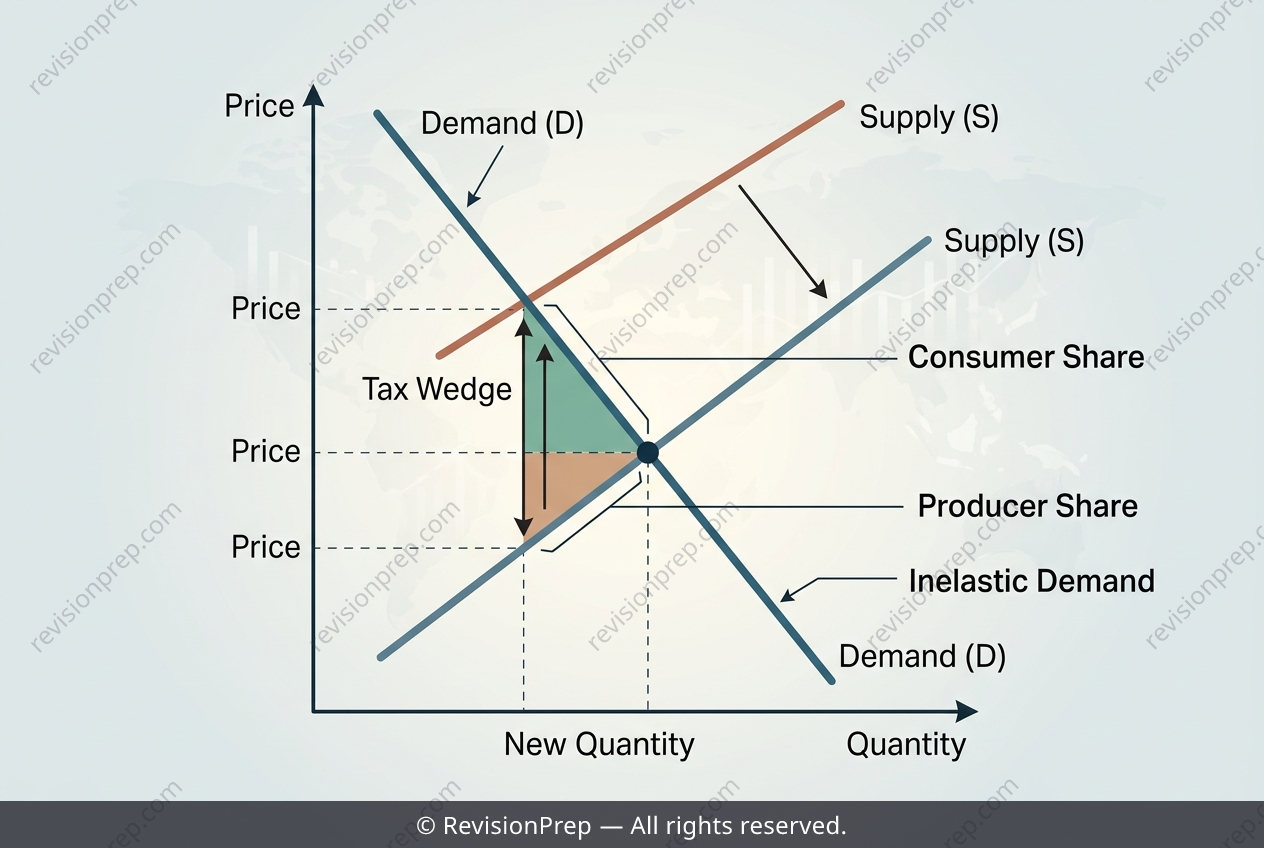
Economics: How Elasticity Determines Tax Incidence
Who really pays a tax? In microeconomics, the answer is rarely the person who physically hands the money to the government. When a per-unit tax is imposed on a good, it creates a tax wedge between what consumers pay and what producers receive, shifting the supply curve upward by the exact amount of the tax. This wedge is the heart of tax incidence—the study of how the burden of a tax is split between buyers and sellers in a market. The split is not determined by who legally pays the tax, but by the relative price elasticity of demand and supply. In the case of a sugar-sweetened beverage tax, the consumer price rises while the producer price falls, and the difference between them equals the tax per litre. The key relationship is that the more inelastic side of the market bears the larger share of the burden. If demand is relatively inelastic—because consumers have few close substitutes—quantity demanded falls only slightly, allowing producers to pass most of the tax forward. Conversely, if supply were more elastic, producers could more easily shift production elsewhere, forcing consumers to absorb even more. The burden shares are calculated as the change in price paid by each side divided by the total tax, revealing how the price mechanism transmits the tax through the market’s equilibrium adjustment.
Start practising IB questions today
150,000+ IB-styled questions, criteria-mapped and instantly accessible.