
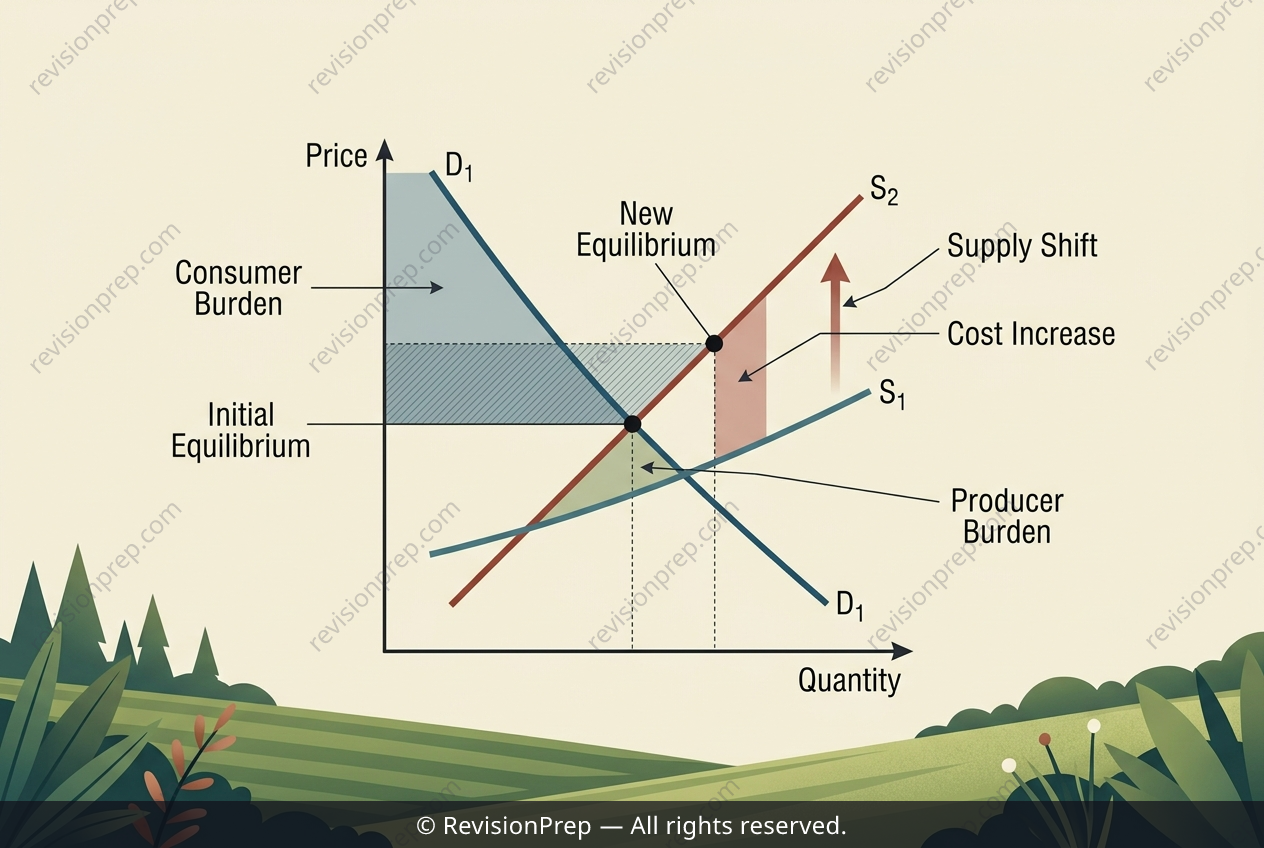
Economics: How Elasticity Shapes Cost Pass-Through
When input costs surge, markets rarely adjust in a single, clean step—instead, the final price you pay depends on a tug-of-war between producers’ costs and consumers’ willingness to buy. In microeconomics, this tug-of-war is captured by two elasticities: price elasticity of demand (PED) and price elasticity of supply (PES). PED measures how much quantity demanded responds to a price change, while PES measures how much quantity supplied responds. Together, they determine the “pass-through” rate—the fraction of a cost increase that firms can shift onto buyers. The formula for this pass-through proportion is PES ÷ (PES + |PED|), which shows that when demand is more elastic (consumers are price-sensitive), firms absorb more of the cost shock; when supply is more elastic, they can pass more along. This mechanism matters because real-world shocks—like a rise in silicon or energy costs for semiconductor chips—ripple through production chains. A chip price increase then feeds into smartphones, where chips are a key input, and the final consumer demand for phones determines how far the shock travels. By linking cost shares, elasticities, and profit margins, you can trace how an initial input cost rise translates into a new equilibrium price at each stage. Understanding this chain helps you see why some industries absorb shocks while others pass them on—and why elasticity, not just cost, dictates who ultimately pays.
Start practising IB questions today
150,000+ IB-styled questions, criteria-mapped and instantly accessible.