
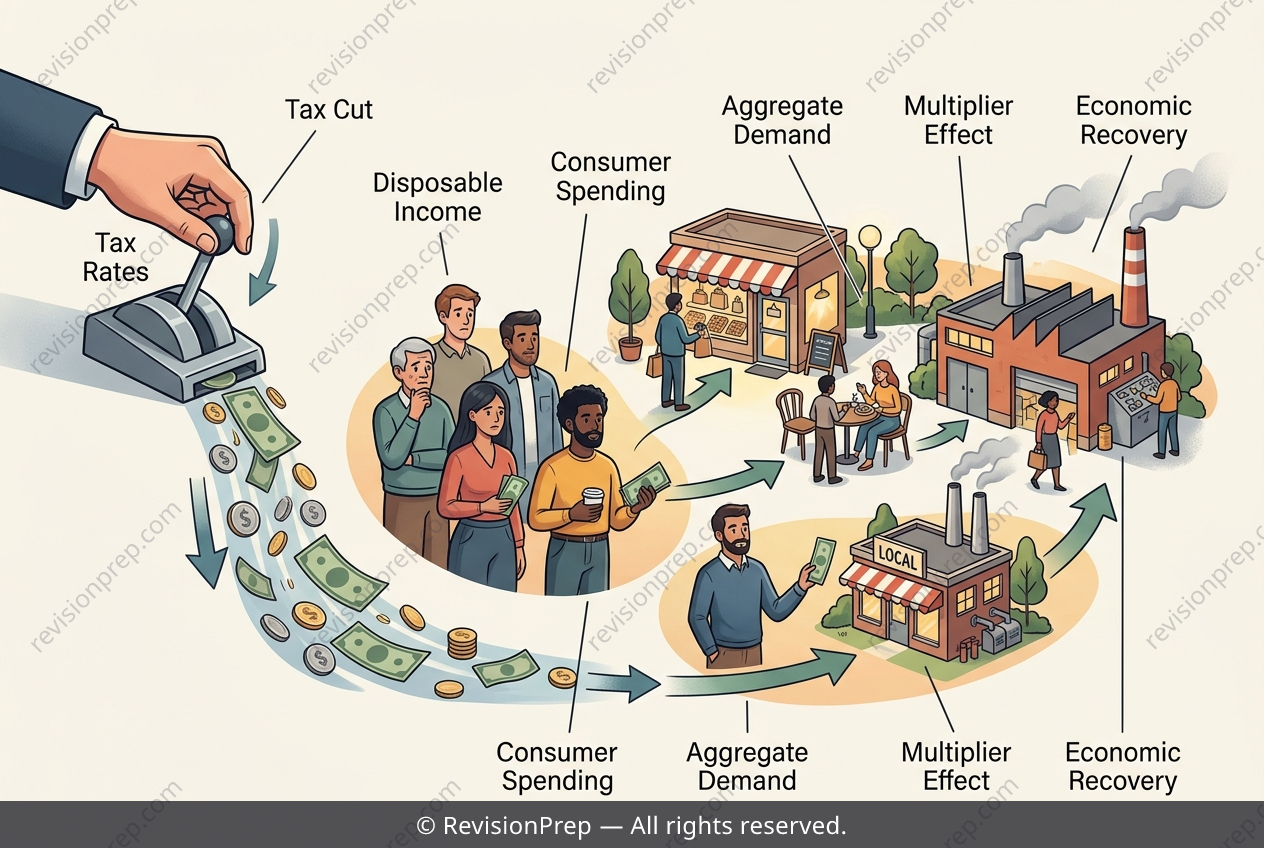
Economics: How Fiscal Policy Closes a Recessionary Gap
Expansionary fiscal policy is the use of higher government spending or lower taxes to raise aggregate demand (AD) in an economy. It matters most during a recession, when output falls short of potential GDP and a recessionary gap opens up. Governments reach for it because private spending alone may not be enough to restore full employment. The mechanics run through household behaviour. A cut in personal income tax lifts disposable income, so consumption (C) rises. Since C is the largest component of AD (AD = C + I + G + (X − M)), the AD curve shifts rightward and real GDP climbs toward potential GDP. The multiplier effect then amplifies this: each round of spending becomes income for someone else, inducing further consumption, so the final rise in real GDP exceeds the initial stimulus.
Start practising IB questions today
150,000+ IB-styled questions, criteria-mapped and instantly accessible.