
Economics: How Fiscal Policy Widens Income Inequality
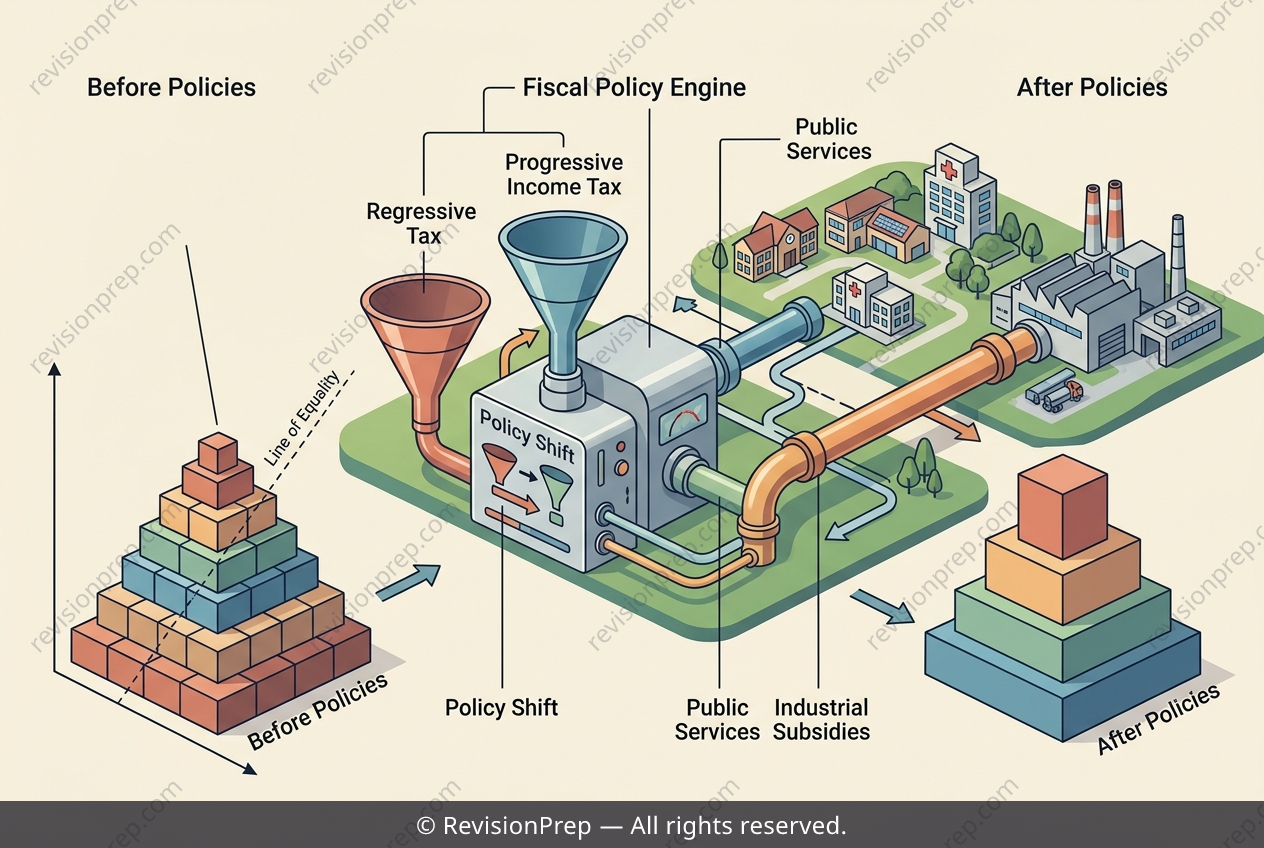
Fiscal policy does more than steer aggregate demand — it redistributes income, and those distributional effects are often the most politically and socially consequential. When a government changes tax rates or spending priorities, it reshapes the disposable income available to different households, shifting how national income is shared across the population. The Lorenz curve and the Gini coefficient capture this: a Gini rising toward 1, or a Lorenz curve bowing further from the diagonal of perfect equality, signals that income is concentrating among fewer people. Country X illustrates how the design of fiscal tools drives that outcome. A regressive consumption tax such as a flat VAT takes a larger share of income from poorer households, who spend more of what they earn. Cutting the top marginal income tax rate raises high earners' post-tax income, while reduced spending on education and healthcare erodes human capital investment for lower-income groups. Together, these measures widen the gap between the top and bottom of the distribution, entrenching inequality structurally rather than temporarily.
Start practising IB questions today
150,000+ IB-styled questions, criteria-mapped and instantly accessible.