
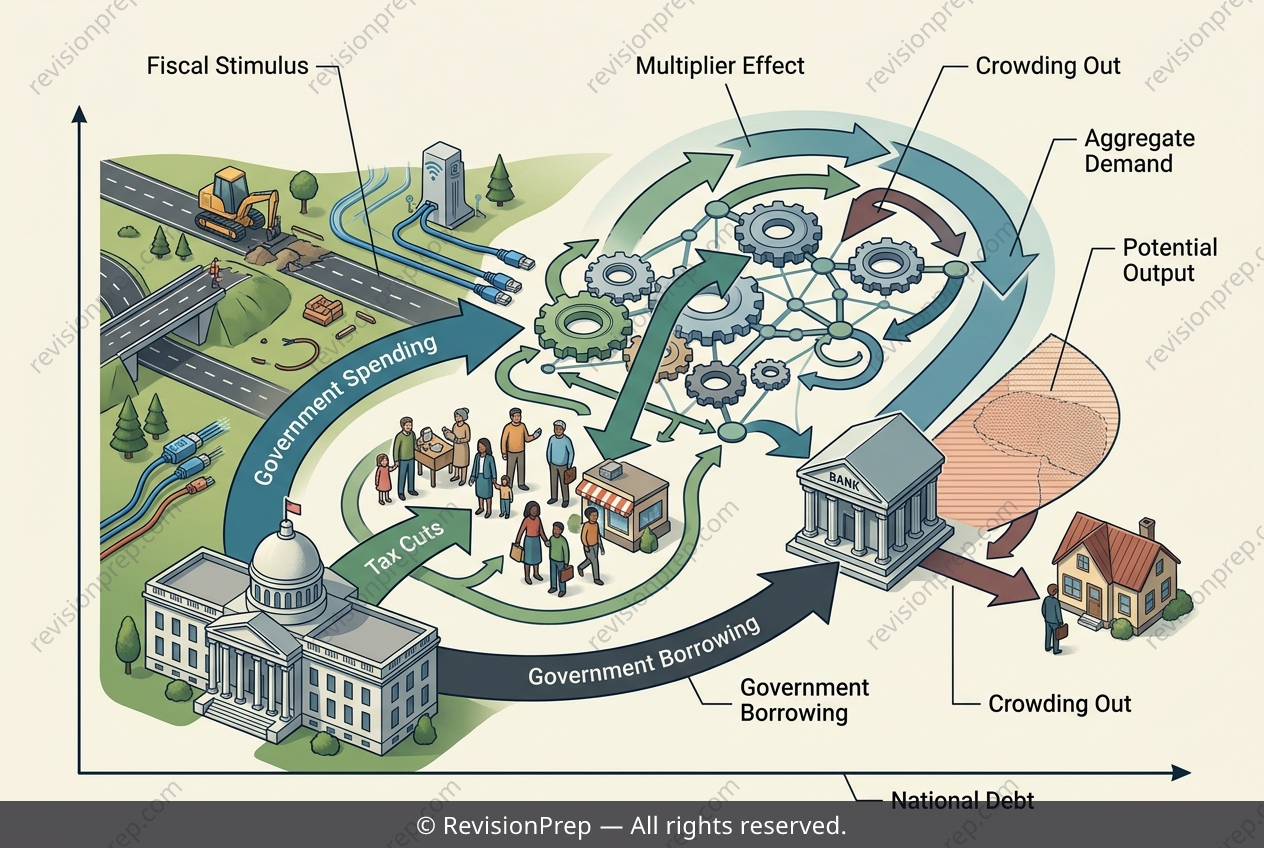
Economics: How Fiscal Stimulus Works and What Limits It
Expansionary fiscal policy is the deliberate use of government spending and taxation to stimulate aggregate demand and close a negative output gap. When a government raises spending on infrastructure or cuts income tax rates, it directly increases the G component of AD and indirectly lifts consumption by raising household disposable income, shifting the AD curve to the right. The size of the resulting change in national income depends on the multiplier, k = 1 / (1 - MPC), which shows how an initial injection ripples through the economy as income is re-spent. A higher MPC means a larger multiplier and a bigger final rise in real GDP. Yet the policy's effectiveness is rarely absolute: the upward-sloping SRAS curve means some stimulus feeds into higher prices rather than output, and constraints such as a high national debt or a relatively closed economy can dampen the impact.
Start practising IB questions today
150,000+ IB-styled questions, criteria-mapped and instantly accessible.