
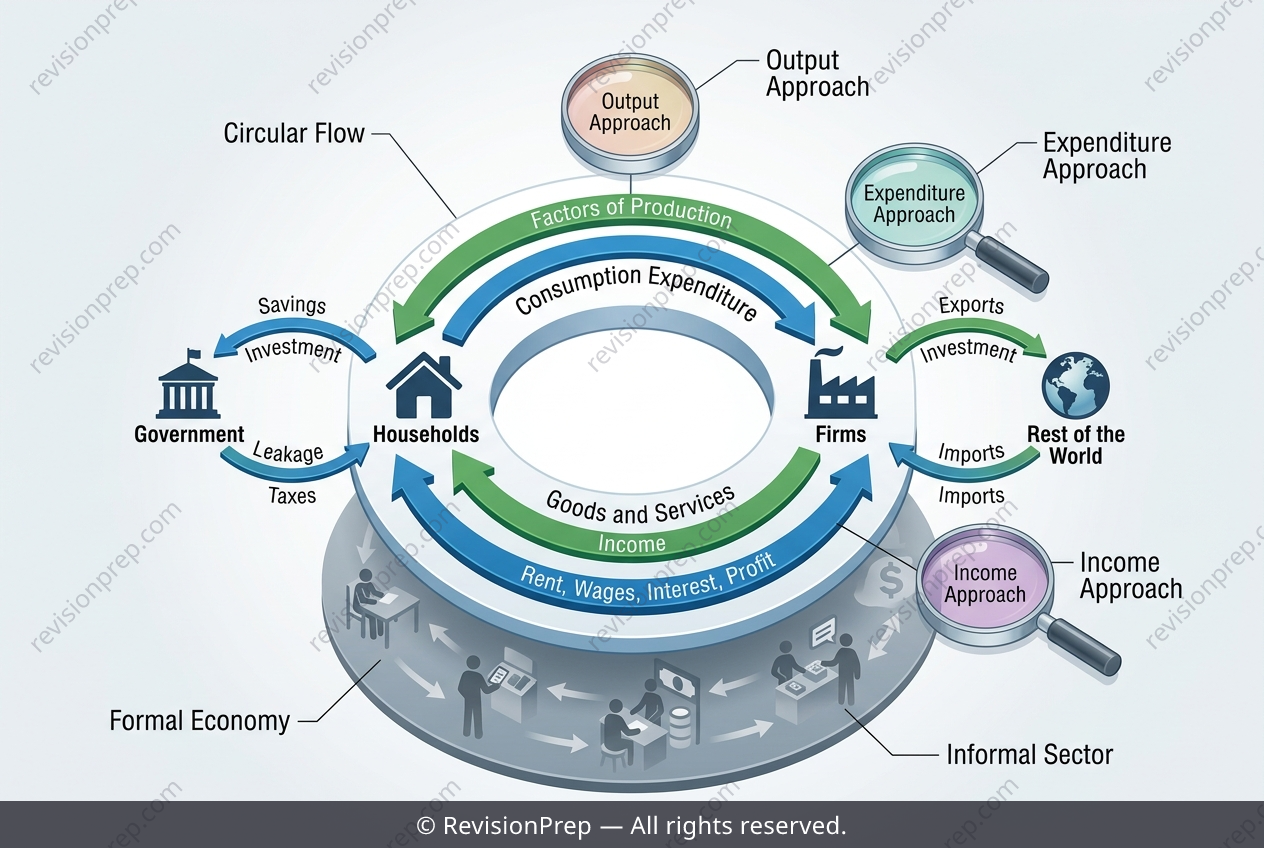
Economics: How GDP Links Output, Income, Expenditure
National income accounting rests on a simple but powerful idea: in the circular flow of income, firms produce output and pay factor incomes — wages, rent, interest and profit — to households, who then spend that income on goods and services. Because every transaction has both a buyer and a seller, the total value of output, total factor income and total expenditure on final goods and services are three views of the same economy, captured by the identity output ≡ income ≡ expenditure, and summarised in the expenditure formula GDP = C + I + G + (X − M). This equivalence matters because governments rely on it to measure growth, yet each approach has blind spots. Vietnam's informal sector — street vendors, unregistered businesses and subsistence farming — is estimated at 15–20% of actual GDP, so unrecorded value added and cash wages slip through the output and income approaches, while consumption surveys and customs records give the expenditure approach a relative advantage.
Start practising IB questions today
150,000+ IB-styled questions, criteria-mapped and instantly accessible.