
Economics: How Human Capital Drives Long-Run Growth
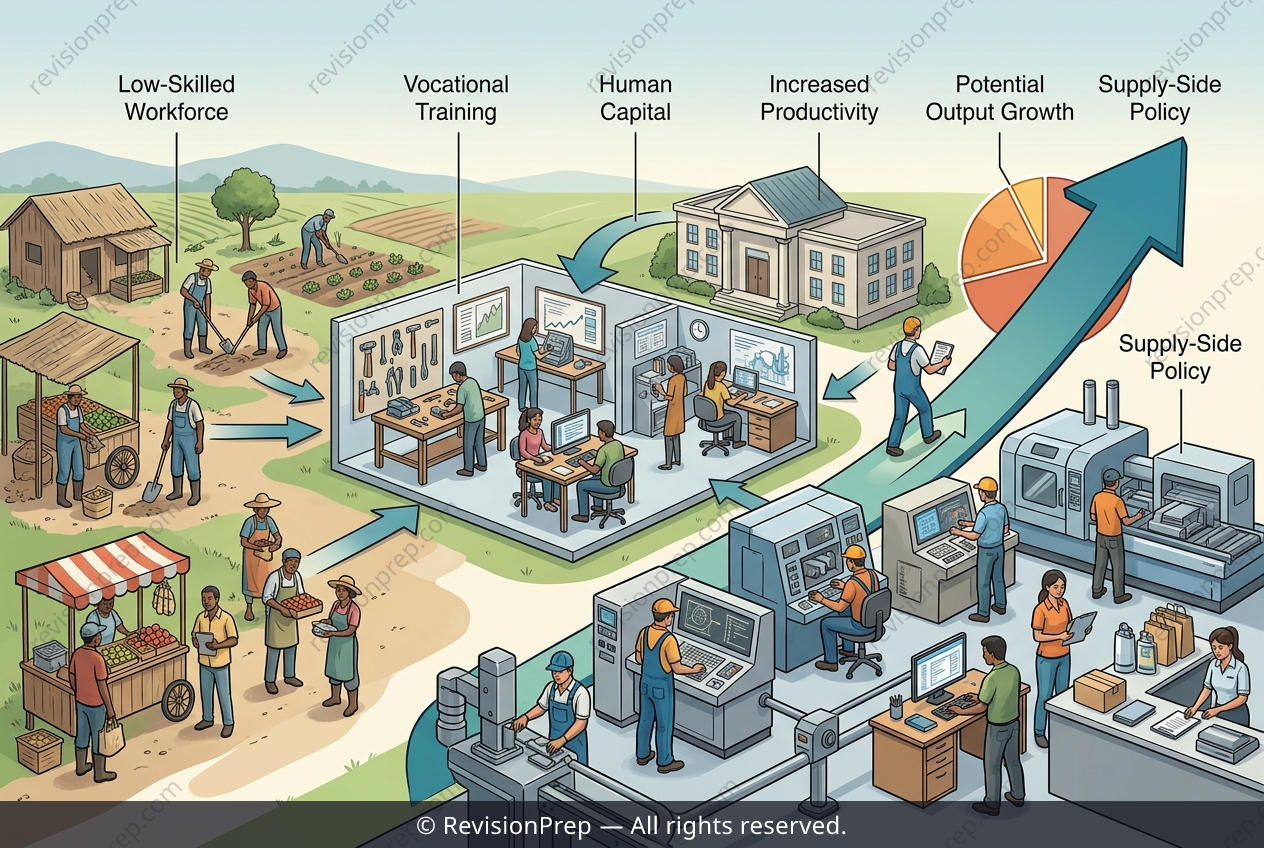
Human capital development sits at the heart of long-run macroeconomic performance. When workers gain formal skills through education and training, their output per worker rises, expanding an economy's productive capacity. This is captured by a rightward shift of the vertical LRAS curve, moving potential output from Y1 to Y2 on an AD/AS diagram, with the price level on the vertical axis and real GDP on the horizontal. This matters because sluggish labour productivity growth, especially in economies where many workers remain in small family farms and informal urban services, limits living standards and competitiveness. Supply-side policies such as vocational training or labour market deregulation aim to lift productivity by improving human capital, reducing labour costs, and shifting workers toward higher-productivity sectors. The key relationship is that higher output per worker raises potential output, though time lags and reduced private investment can offset these gains.
Start practising IB questions today
150,000+ IB-styled questions, criteria-mapped and instantly accessible.