
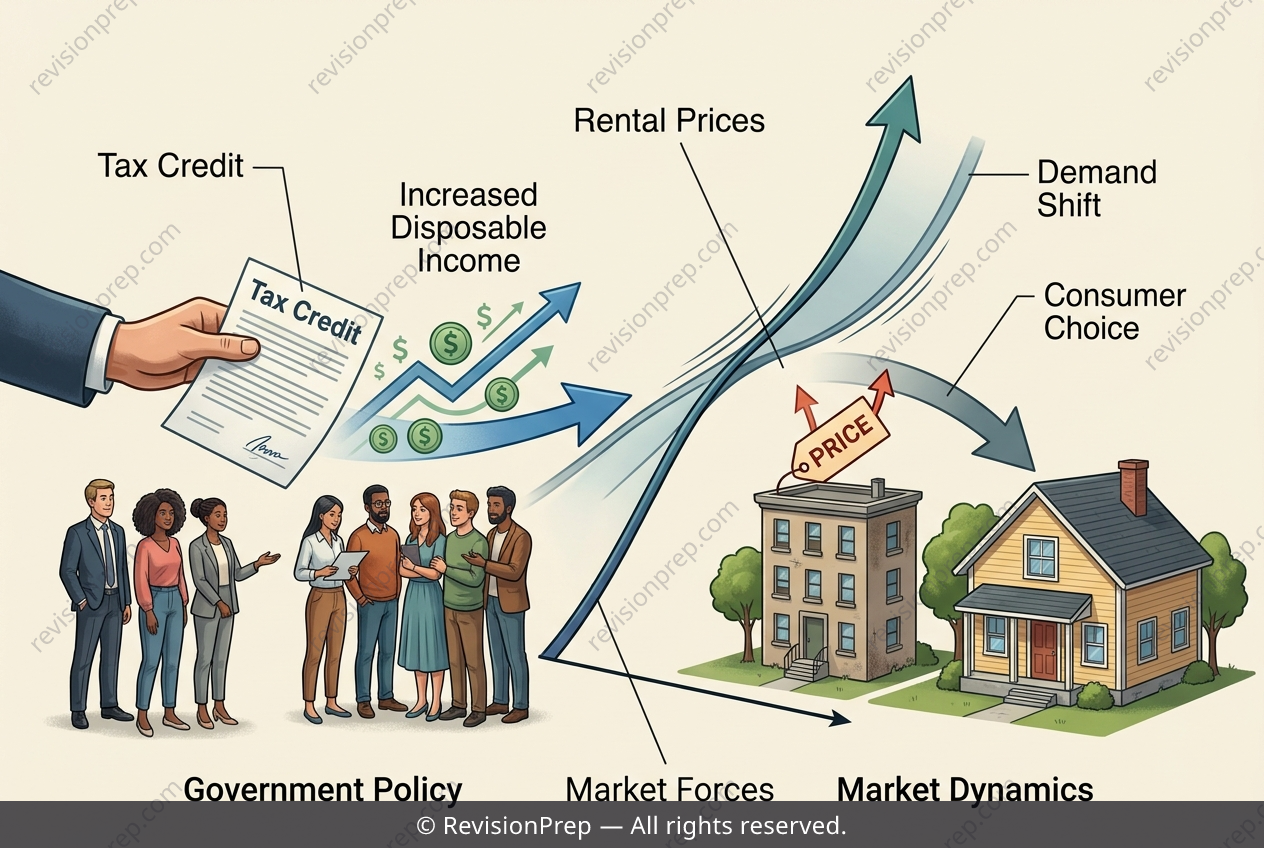
Economics: How Income and Rentals Shift Housing Demand
Market demand is never static—it shifts whenever the underlying conditions of buyers change. In microeconomics, the demand curve represents the relationship between price and quantity demanded, ceteris paribus, but that curve moves when determinants such as income, the price of substitutes, or consumer preferences alter. For housing in a developed economy, these shifts are especially visible because housing is a normal good: when disposable income rises, so does the willingness to pay for owner-occupied homes. A government tax credit, like the USD 10,000 offered to first-time buyers, directly increases that income, pushing the entire demand curve rightward. The story deepens when substitutes enter the picture. Rental apartments serve as a close alternative to buying a home; if rental prices jump—say, by 20% after deregulation—renting becomes relatively more expensive, prompting consumers to switch toward ownership. This further shifts demand to the right, compounding the income effect. The result is a higher equilibrium price and quantity, though the magnitude depends on supply elasticity. In the short run, housing supply is price inelastic, meaning a steep supply curve, so the demand surge translates mostly into price increases rather than quantity expansion. Understanding these interconnected determinants—income effects, cross-price relationships, and supply responsiveness—explains why markets rarely settle at a single, static equilibrium.
Start practising IB questions today
150,000+ IB-styled questions, criteria-mapped and instantly accessible.