
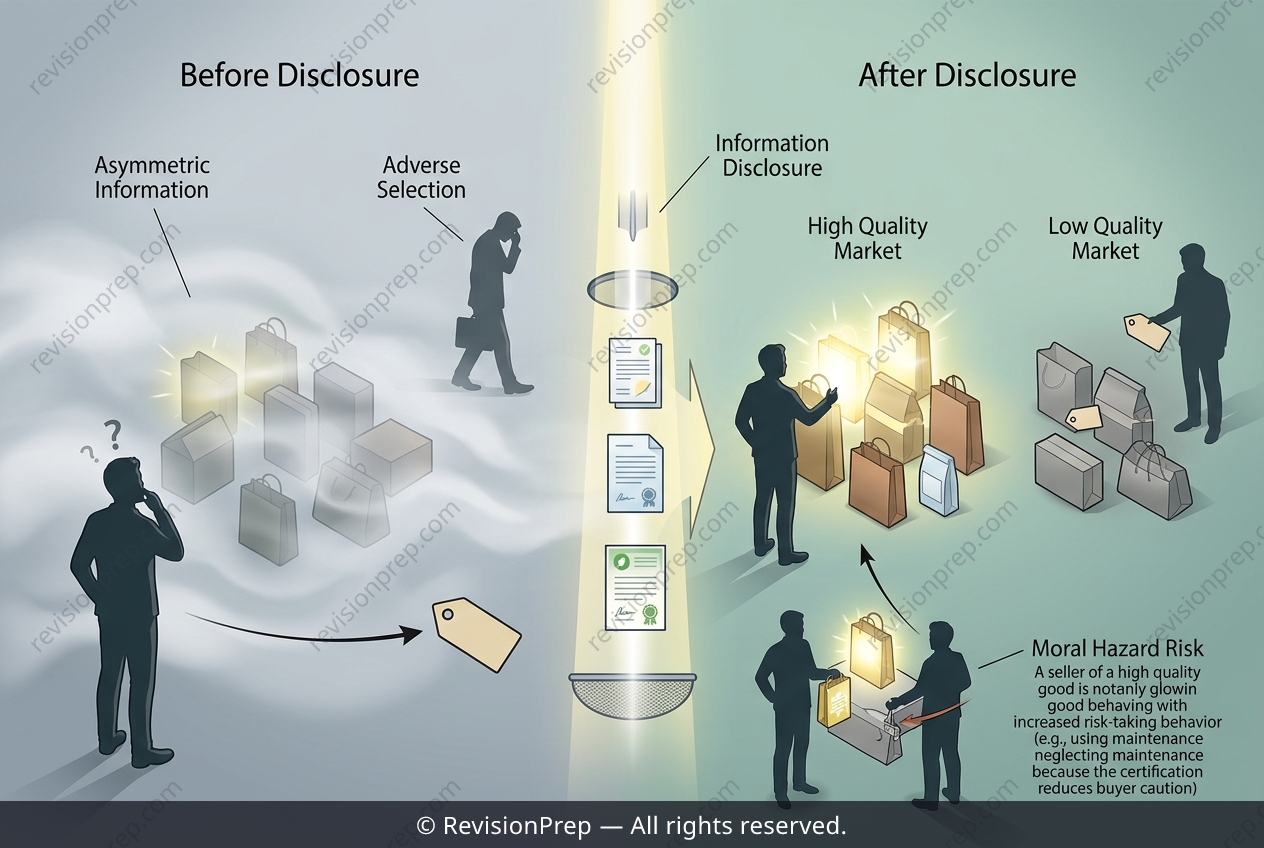
Economics: How Information Restores Gains from Trade
Imagine walking onto a used-car lot. The seller knows every bump and repair; you know only the paint job. This imbalance—where one party knows more than the other—is asymmetric information, and it can unravel an entire market. In the market for pre-owned automobiles, buyers, unable to tell a reliable "peach" from a troublesome "lemon," rationally offer a single price reflecting average quality. That price sits below what peach-sellers are willing to accept, so the good cars exit, leaving only lemons. The market shrinks below its socially optimal quantity, destroying allocative efficiency. The fix is a mandatory certification scheme, like a Vehicle History Report (VHR). By forcing sellers to reveal accident history and odometer readings, the VHR transforms hidden information into public knowledge. For high-quality cars, demand shifts right as trust returns, raising both price and quantity traded toward the efficient level. For low-quality cars, demand shifts left, as buyers no longer overpay for hidden flaws. The result: resources flow away from lemons and toward peaches, restoring the gains from trade that asymmetric information had erased.
Start practising IB questions today
150,000+ IB-styled questions, criteria-mapped and instantly accessible.