
Economics: How Intervention Reshapes Market Welfare
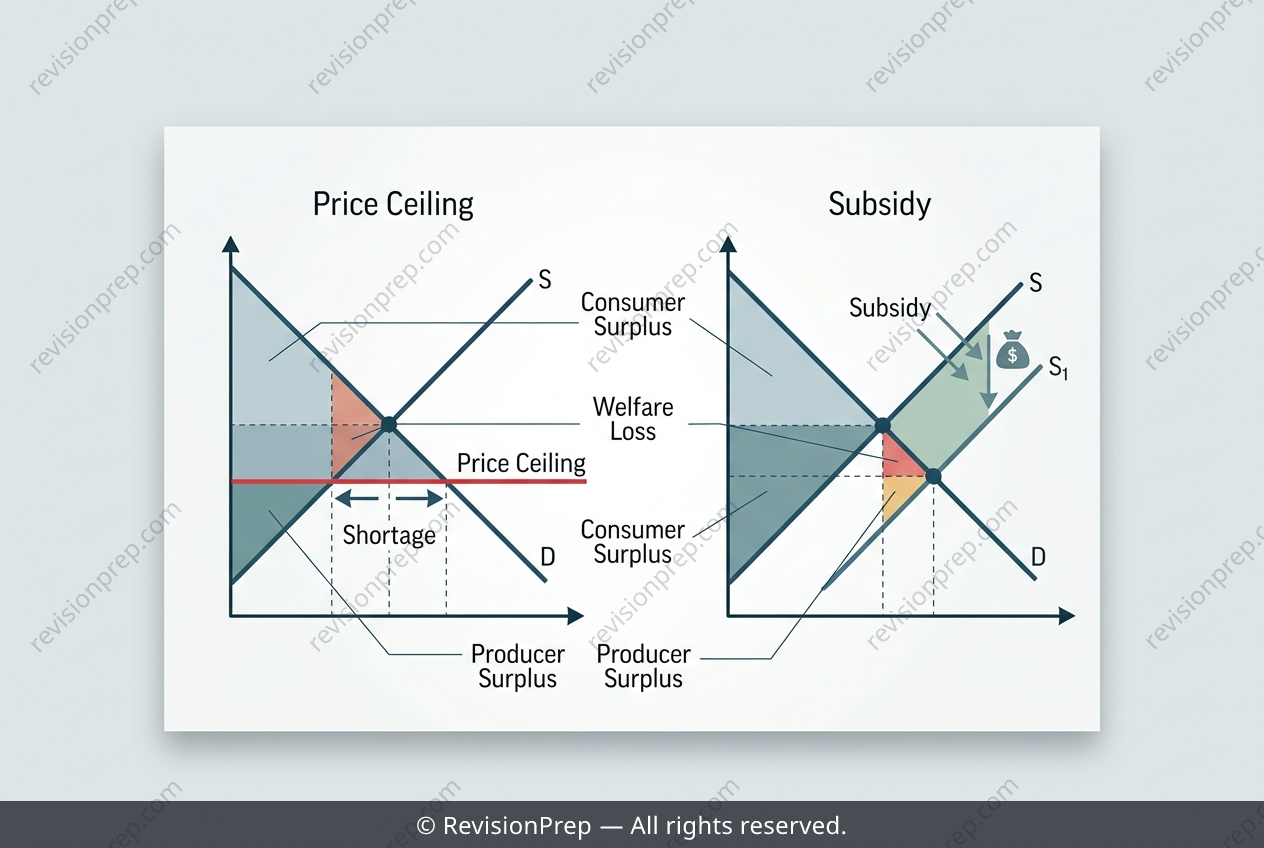
When governments step into markets, they rarely do so neutrally—every intervention reshapes who gains, who loses, and how much total welfare society enjoys. In microeconomics, government intervention in markets refers to policies like price controls or subsidies that alter the natural equilibrium determined by supply and demand. For an IB Economics HL student, understanding these tools is essential because they reveal the trade-offs between efficiency and equity, especially when markets fail to deliver affordable essentials. Consider a staple like rice, where demand is price inelastic in the short run—consumers cannot easily switch away—while supply is moderately elastic. A price ceiling set below equilibrium creates a classic shortage: quantity supplied falls along the supply curve, while quantity demanded rises along the demand curve, leaving a gap that represents lost transactions. The welfare loss triangle, bounded by the supply curve, demand curve, and the reduced quantity traded, shows that total surplus shrinks compared to the free market. Meanwhile, a producer subsidy shifts the supply curve downward by the subsidy amount, lowering the consumer price and raising the producer price, with the new equilibrium quantity higher than before. Because demand is inelastic, consumers capture a larger share of the subsidy’s benefit, but the government bears the fiscal cost. Both policies alter consumer surplus, producer surplus, and deadweight loss—yet they do so through opposite mechanisms: one caps prices, the other lowers production costs.
Start practising IB questions today
150,000+ IB-styled questions, criteria-mapped and instantly accessible.