
Economics: How Productivity Shifts LRAS and SRAS
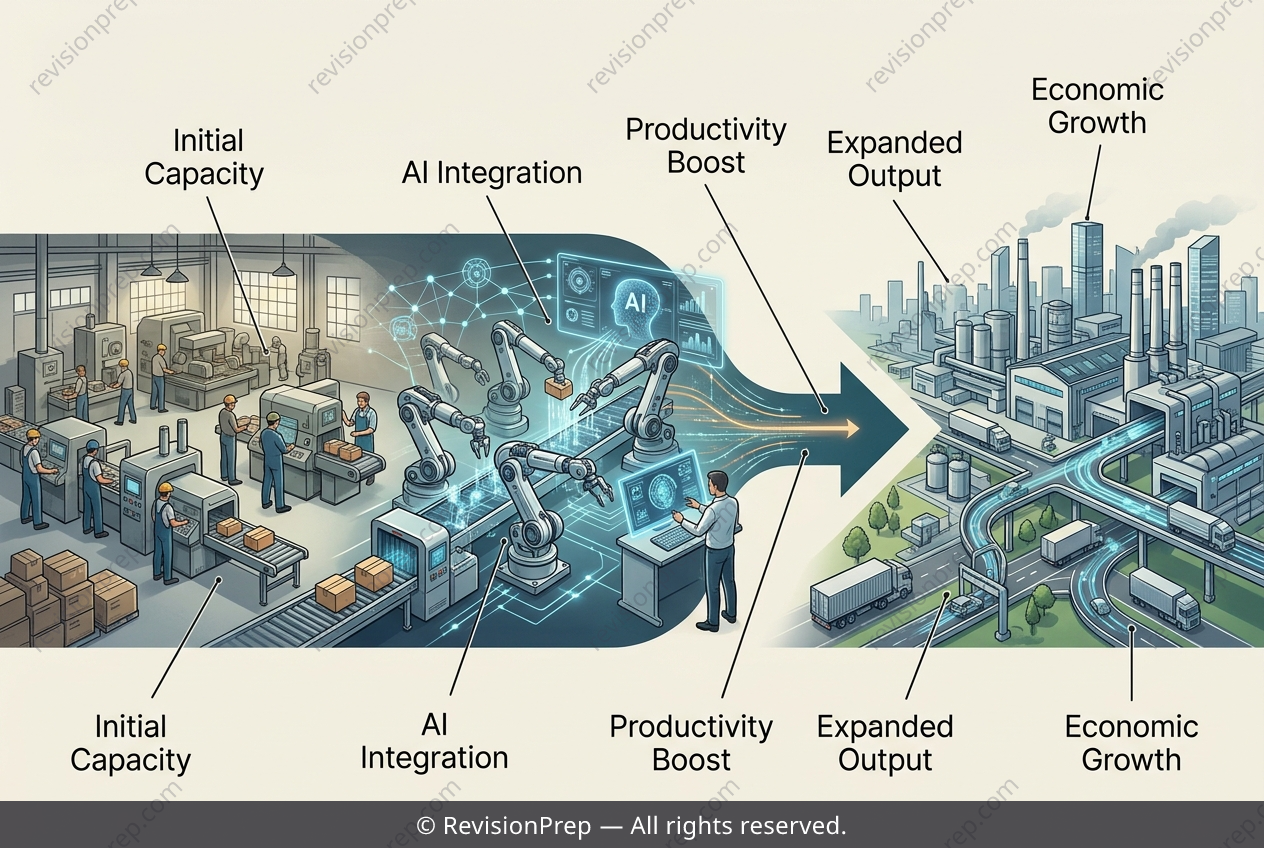
Long-run aggregate supply represents an economy's productive capacity when all resources are fully employed, drawn as a vertical line at potential output, Yf. Because it depends on the quantity and quality of factors of production rather than the price level, LRAS only shifts when something changes the economy's underlying ability to produce. This matters because a rightward shift in LRAS signals genuine economic growth, not just a temporary boost in output. When productivity rises, as with widespread AI adoption in manufacturing, the productive capacity of the economy expands, shifting LRAS from Yf1 to Yf2. Crucially, higher productivity also lowers unit costs of production, shifting SRAS right. The new long-run equilibrium sits where AD, SRAS2 and LRAS2 intersect, so real output rises while the price level falls. The SRAS shift is the adjustment mechanism that carries the economy to its new potential output.
Start practising IB questions today
150,000+ IB-styled questions, criteria-mapped and instantly accessible.