
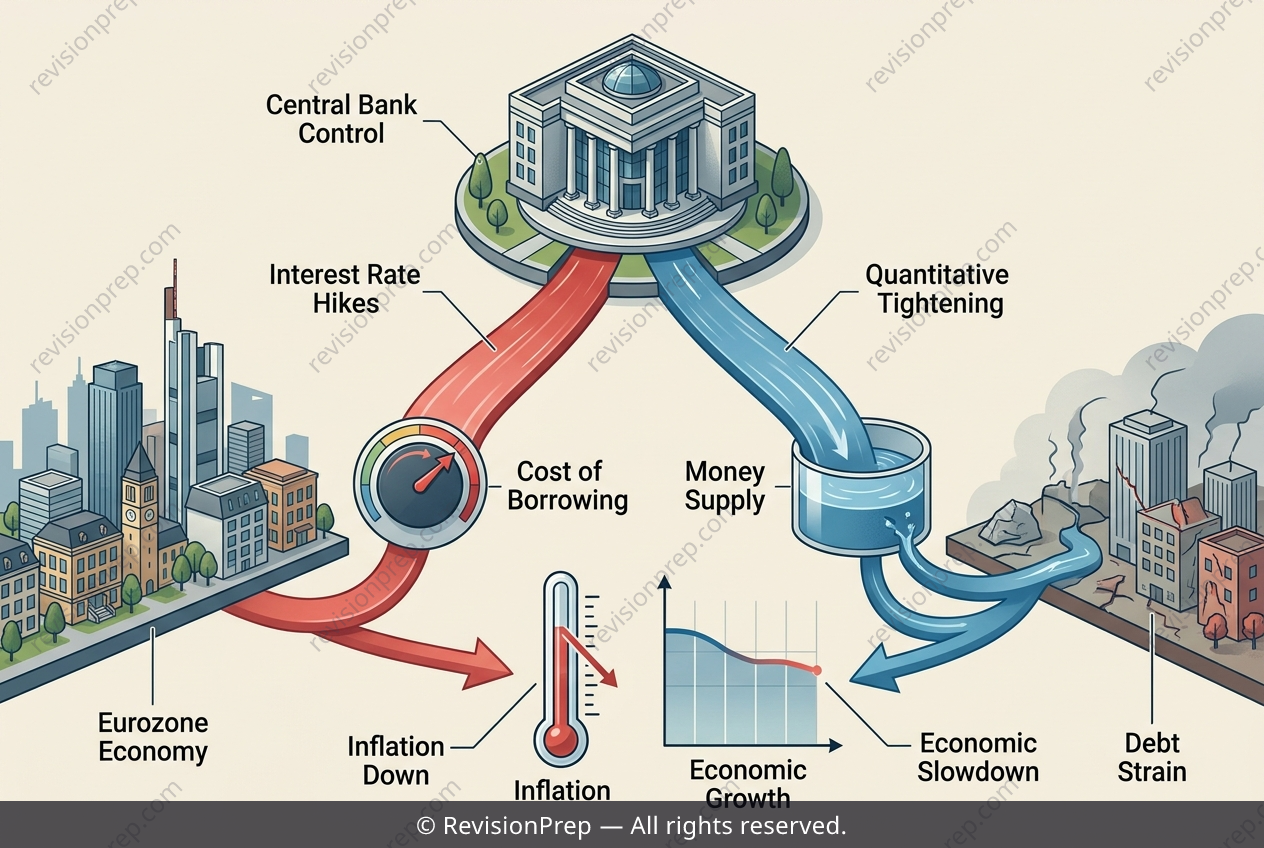
Economics: How Rate Hikes and QT Reduce Aggregate Demand
When a central bank tightens policy, it rarely pulls just one lever. Conventional monetary policy sets a short-term policy rate — the ECB's refinancing rate — which feeds through to commercial bank lending rates and shapes consumption and investment. Quantitative tightening works differently: the central bank shrinks its balance sheet by letting maturing bonds expire without reinvestment, contracting the money supply and pushing up long-term bond yields. These channels matter because they ultimately converge on aggregate demand, AD = C + I + G + (X − M). Higher short-term rates dampen C and I; rising long-term yields further suppress investment and asset prices; and a stronger euro weakens net exports. Together, simultaneous tightening shifts AD leftward, easing inflation toward target but raising the risk of overshooting into recession — especially across a heterogeneous Eurozone.
Start practising IB questions today
150,000+ IB-styled questions, criteria-mapped and instantly accessible.