
Economics: How Supply and Demand Shocks Drive Inflation
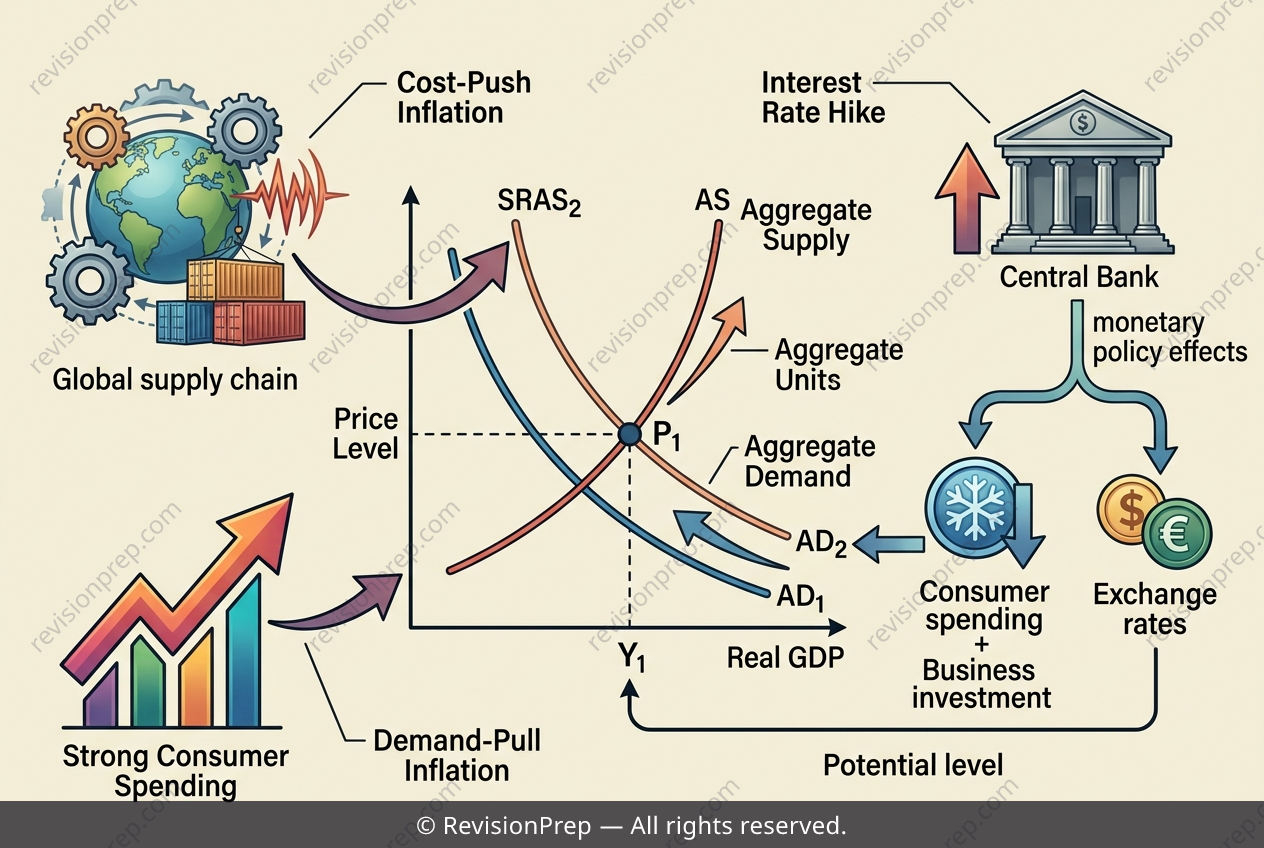
Inflation is a sustained rise in the general price level, and it can originate from either the supply side or the demand side of the economy. Cost-push inflation occurs when firms' production costs rise — for example, a sharp increase in global energy prices raises input costs across sectors, shifting short-run aggregate supply (SRAS) leftward so that the price level rises while real GDP falls. Demand-pull inflation, by contrast, arises from excess aggregate demand: as an economy recovers from recession, rising consumer confidence lifts household spending, shifting aggregate demand (AD) rightward and raising both the price level and real GDP. Distinguishing these two causes matters because they call for different policy responses. Monetary policy, typically conducted by raising the key interest rate, works by increasing borrowing costs, which reduces consumption and investment, shifting AD leftward to ease demand-pull pressures. Understanding how supply shocks, spending recoveries, and interest rate changes interact — and how wage demands can feed further price rises — is central to analysing inflation and stabilisation policy.
Start practising IB questions today
150,000+ IB-styled questions, criteria-mapped and instantly accessible.