
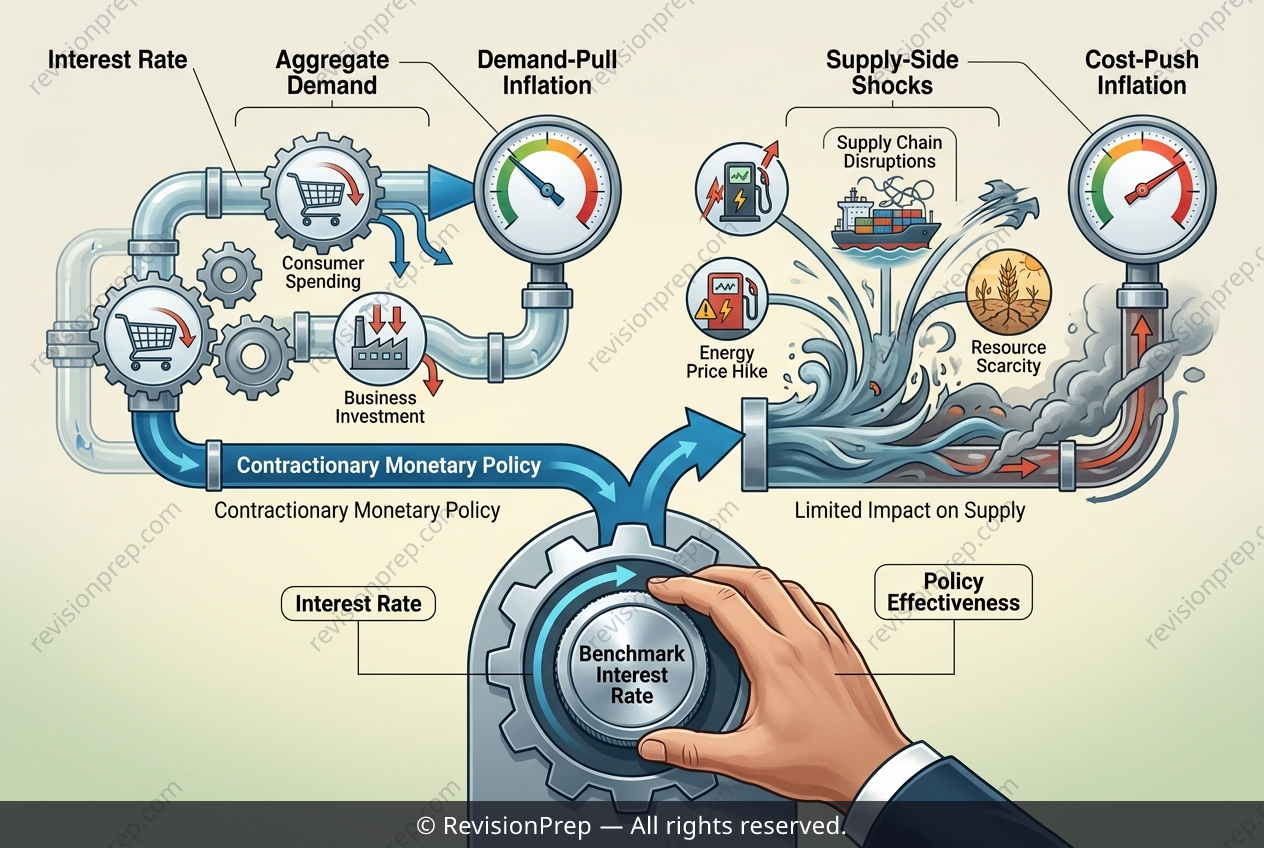
Economics: Why Rate Hikes Cannot Fix Cost-Push Inflation
Monetary policy works through a chain of effects: when a central bank raises its benchmark rate, borrowing becomes costlier, so household consumption (C) and firm investment (I) fall, shifting aggregate demand left from AD1 to AD2. In an AD/AS diagram, with Price Level on the vertical axis and Real Output on the horizontal, this moves equilibrium from P1, Y1 to a lower price level P2 and lower output Y2 — easing demand-pull inflation. This matters because the transmission mechanism does not operate in isolation. Higher rates can also anchor inflation expectations, moderating wage demands, and attract capital inflows that support the exchange rate, curbing import-cost inflation. Yet when inflation is cost-push — driven by supply shocks that shift SRAS left — reducing AD cannot restore lost output or lower input costs. Nigeria in 2023 illustrates this tension between demand-side policy and supply-side causes.
Start practising IB questions today
150,000+ IB-styled questions, criteria-mapped and instantly accessible.