
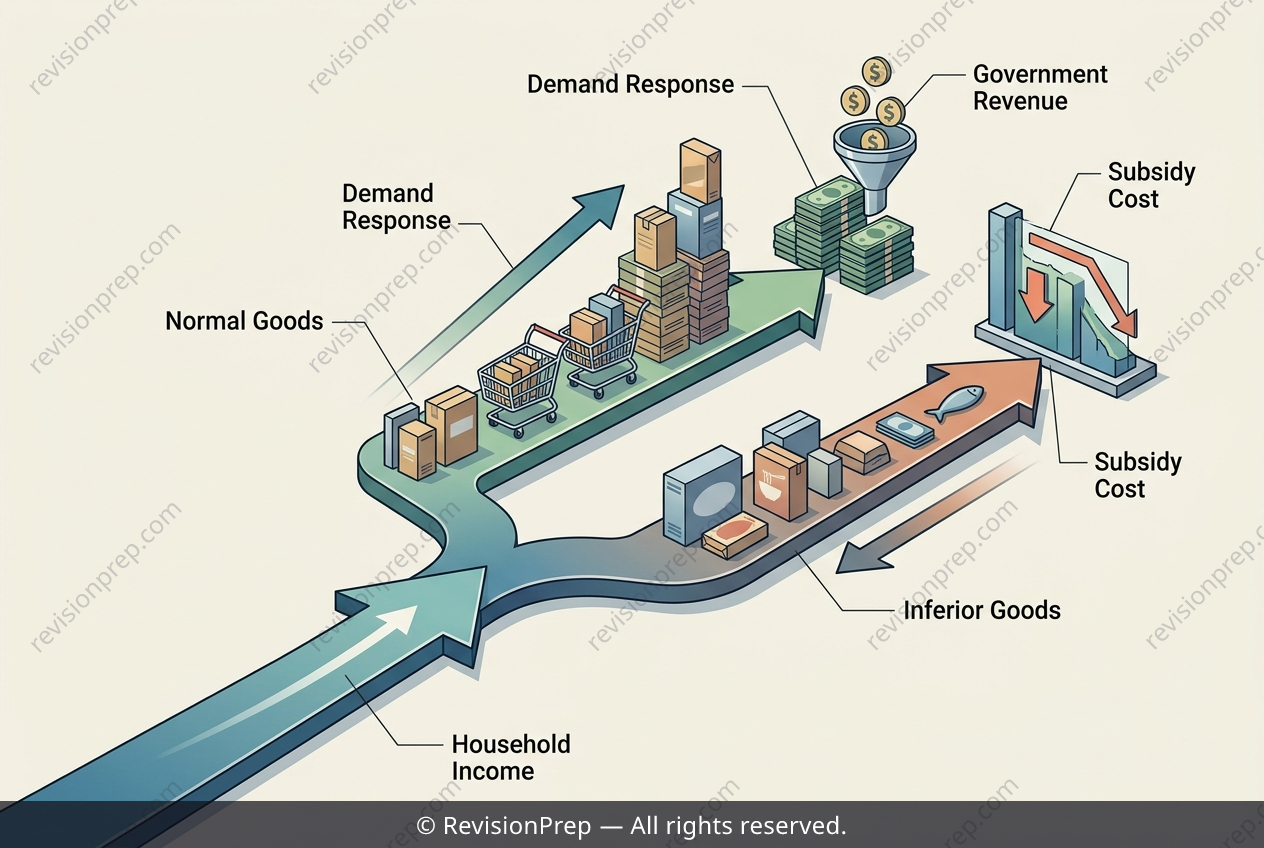
Economics: How YED Predicts Tax and Subsidy Costs
Income elasticity of demand (YED) measures how responsive the quantity demanded of a good is to a change in consumer income, calculated as the percentage change in quantity demanded divided by the percentage change in income. This single ratio tells economists whether a good is a normal good (positive YED) or an inferior good (negative YED), and for normal goods, whether it is a necessity (YED between 0 and 1) or a luxury (YED greater than 1). For governments, YED is not just a textbook metric—it is a practical tool for predicting how tax revenues and subsidy expenditures will shift as an economy grows or contracts. The concept connects directly to fiscal policy design. When incomes rise, a normal necessity like fresh fish sees demand increase, but less than proportionally, meaning a value-added tax on it will generate steady but modest revenue growth. In contrast, an inferior good like instant noodles sees demand fall as incomes rise, so a subsidy aimed at low-income households will automatically cost less over time—without this insight, a government might over-budget for support programs. YED thus links household behaviour to macroeconomic planning, revealing that the same income change can push different goods in opposite directions, with distinct consequences for public finances and consumer welfare.
Start practising IB questions today
150,000+ IB-styled questions, criteria-mapped and instantly accessible.