
Economics: Pacific Island Y — Scarcity and the PPF
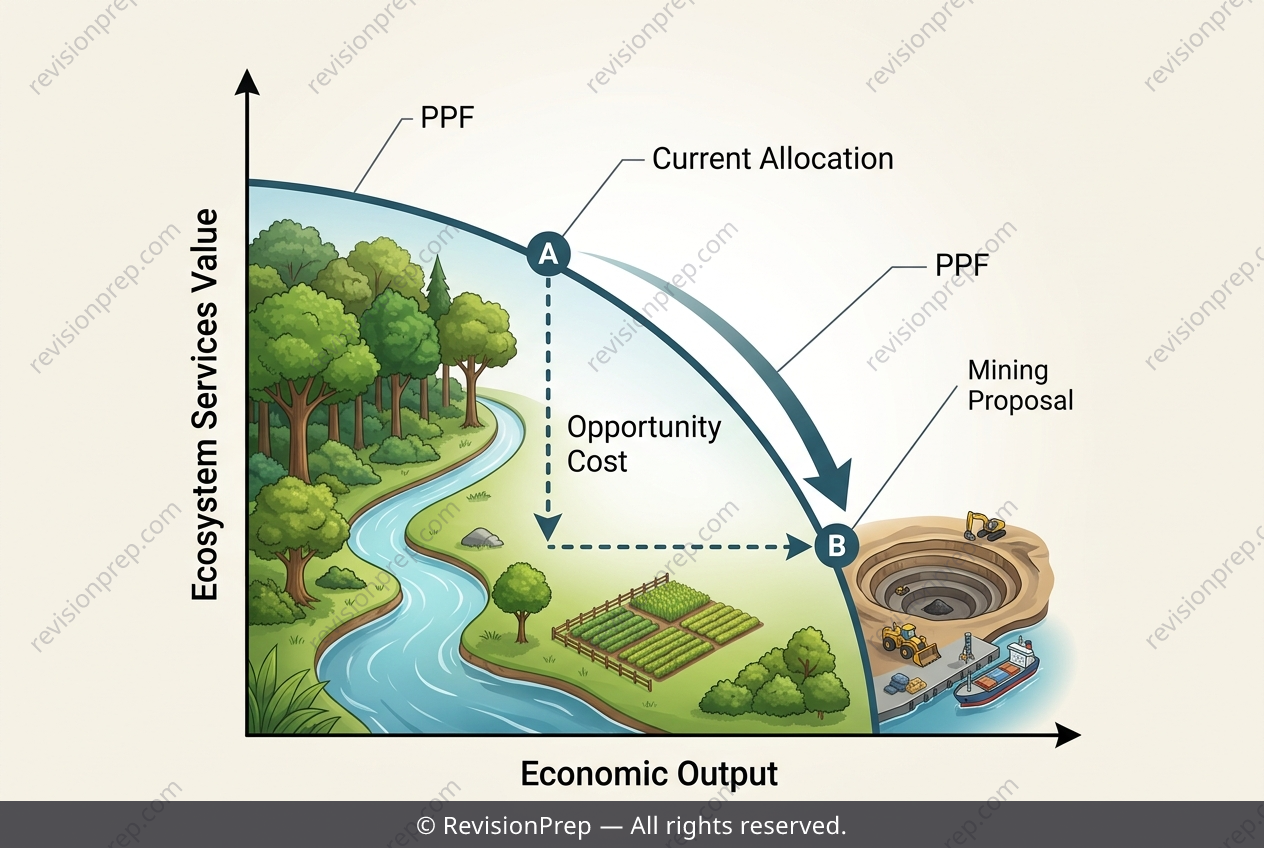
Scarcity is the foundational problem of economics: the gap between our unlimited wants—better roads, hospitals, schools, and income—and the finite resources available to satisfy them. For a small island economy like Pacific Island Y, this gap is stark: only 40% of land is arable, 70% of labour is locked in low-productivity fishing and subsistence farming, and capital is limited to one port, one airport, and 200 km of roads. These constraints mean every choice carries an opportunity cost—the value of the next best alternative foregone. The Production Possibilities Frontier (PPF) visualises this trade-off. On one axis sits forest preservation and ecosystem services; on the other, mineral revenue and capital goods. The current production point hugs the preservation axis, reflecting the island’s reliance on nature. A multinational’s offer to extract rare-earth minerals would shift production along the PPF toward the revenue axis, sacrificing some forest services for a USD 200 million capital injection—potentially funding infrastructure and education. The curve’s shape shows that resources are not perfectly adaptable: converting forested land to mining yields diminishing returns, and the opportunity cost rises as you move along the frontier. Understanding this relationship—between resource limits, forgone alternatives, and the shape of the PPF—is the core of economic reasoning about any real-world choice.
Start practising IB questions today
150,000+ IB-styled questions, criteria-mapped and instantly accessible.