
Economics: Scarcity, Choice and Who Bears the Cost
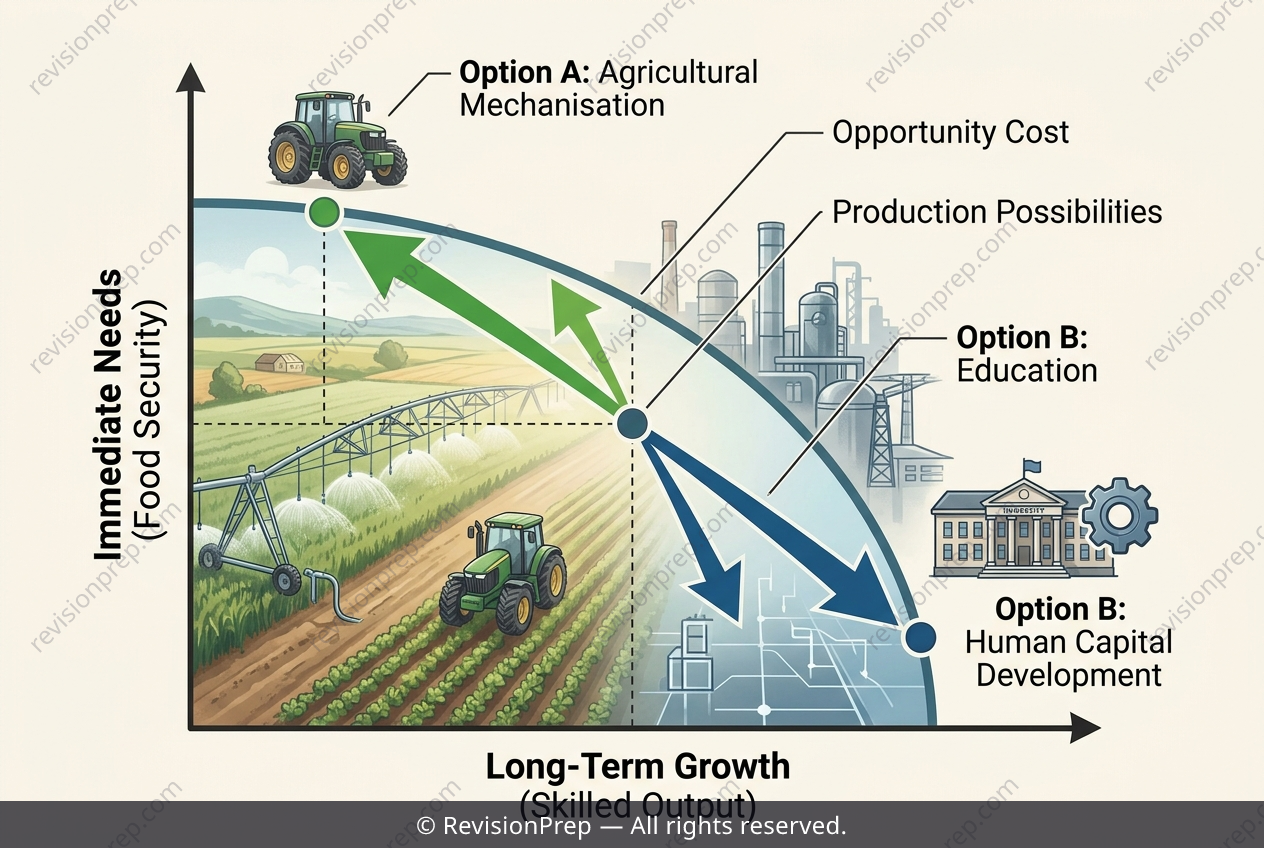
Every economic decision begins with a single, unavoidable fact: resources are limited, but human wants are not. This is scarcity—the gap between what we desire and what we can actually produce. Because of scarcity, we cannot have everything, so every choice forces us to sacrifice something else. That sacrifice is opportunity cost: the value of the next best alternative foregone. In the case of Country X, a finite USD 2 billion loan cannot fund both agricultural mechanisation and long-term human capital investment, so choosing one path automatically means losing the benefits of the other. These three ideas—scarcity, choice, and opportunity cost—are the engine of all economic analysis. They also raise the question of for whom to produce, since every allocation distributes gains and losses unevenly. Option A’s immediate 40% food output boost may feed millions, but it displaces a quarter of agricultural workers, while Option B builds future skills but leaves today’s poor households waiting. With a Gini coefficient of 0.52 already signalling deep inequality, the decision is not just about efficiency—it is about who bears the cost of progress. Understanding how these parts connect helps you see why no policy is ever free.
Start practising IB questions today
150,000+ IB-styled questions, criteria-mapped and instantly accessible.