
Economics: Scarcity, the PPF and Opportunity Cost
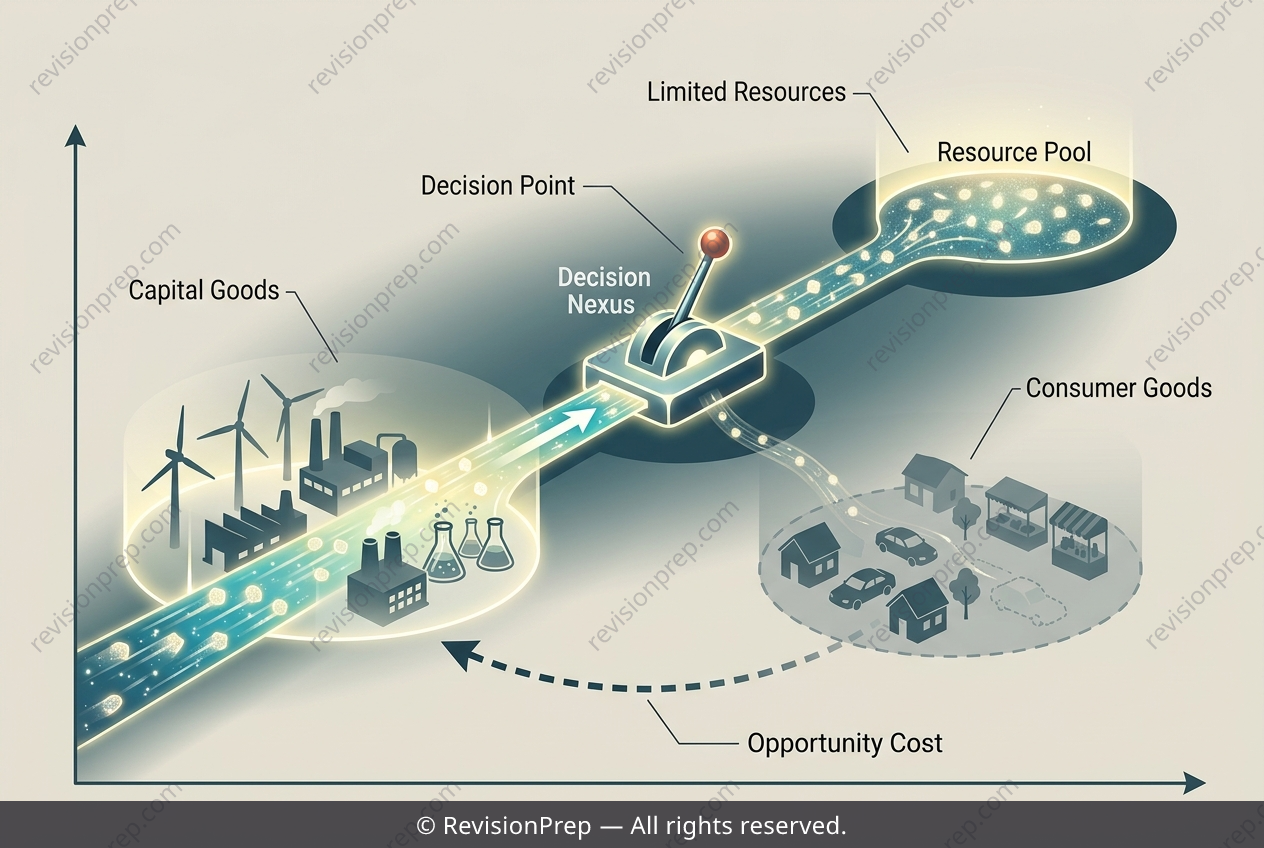
Scarcity is the foundational problem of economics: it exists because our wants are unlimited while the resources available to satisfy them are finite. This single tension forces every society—whether a market economy like the USA or a centrally planned one like North Korea—to make choices about what to produce, how to produce it, and for whom. Without scarcity, there would be no need for economics at all; with it, every decision carries a cost. That cost is opportunity cost, best visualised along a Production Possibility Frontier (PPF). The PPF shows the maximum combinations of two goods—say, capital goods and consumer goods—that an economy can produce with fixed resources and technology. Because the frontier represents full employment, moving from one point to another along it means producing more of one good only by sacrificing some of the other. The amount of consumer goods forgone to gain additional capital goods is precisely the opportunity cost of that choice. This trade-off lies at the heart of how governments allocate limited resources, and it explains why the PPF’s shape and position matter: a bowed-out curve reflects rising opportunity costs, while an outward shift—driven by investment or innovation—represents the only long-term escape from scarcity’s grip.
Start practising IB questions today
150,000+ IB-styled questions, criteria-mapped and instantly accessible.