
Economics: Taxes Act Fast, Education Acts Deep
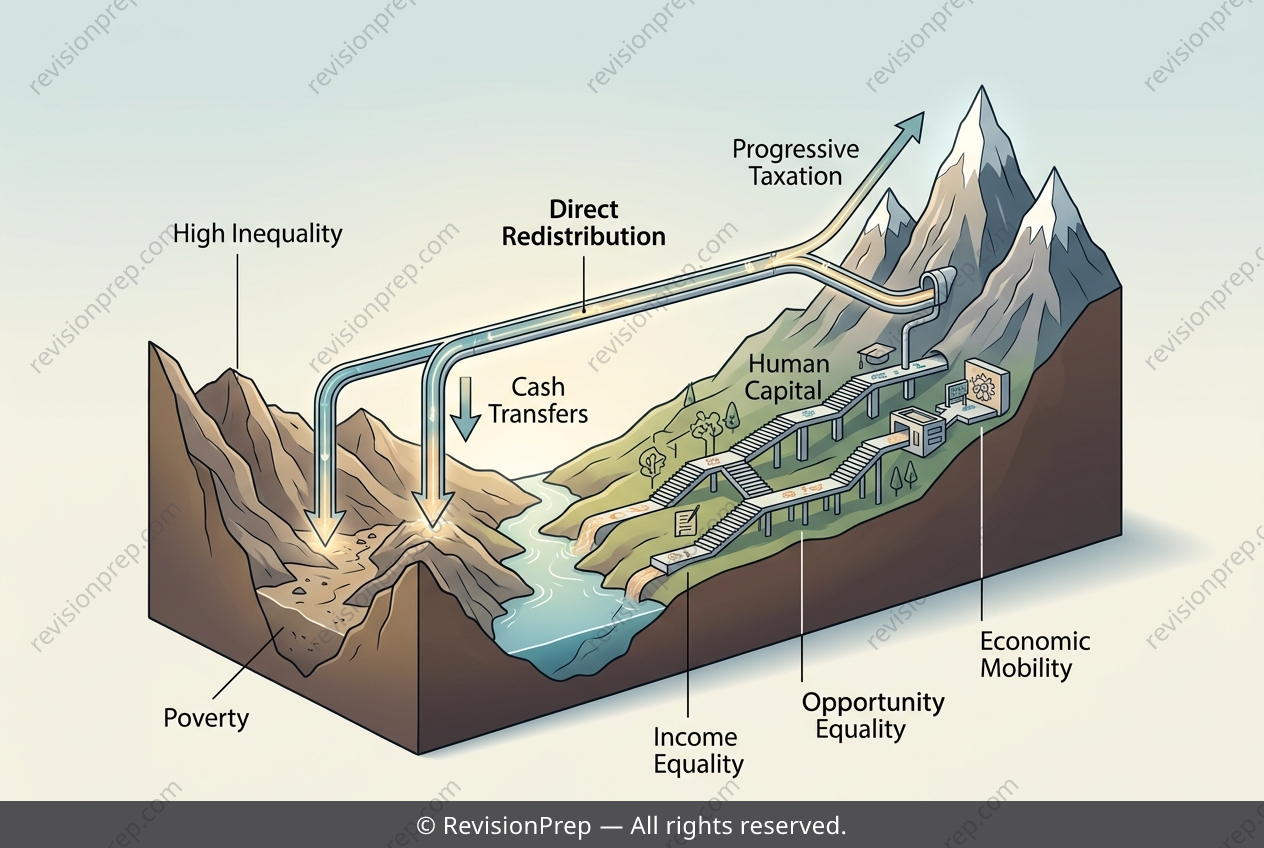
Income inequality is commonly measured using the Gini coefficient, where 0 represents perfect equality and 1 represents perfect inequality. A country with a Gini coefficient of 0.62 therefore experiences highly unequal income distribution, which can be visualised using a Lorenz curve: the further the curve bows away from the 45° line of perfect equality, the higher the Gini coefficient. Governments can intervene to reduce such inequality through fiscal and human capital policies. Progressive taxation and cash transfers compress disposable incomes directly, shifting the Lorenz curve inward and lowering the Gini coefficient in the short run. Universal education and vocational training, by contrast, tackle inequality of opportunity at its roots, improving skills and long-run earnings potential. Understanding how these mechanisms differ in speed, effectiveness, and sustainability is central to evaluating any government's strategy for reducing inequality.
Start practising IB questions today
150,000+ IB-styled questions, criteria-mapped and instantly accessible.