
Economics: The Pigouvian Tax and Its Real Limits
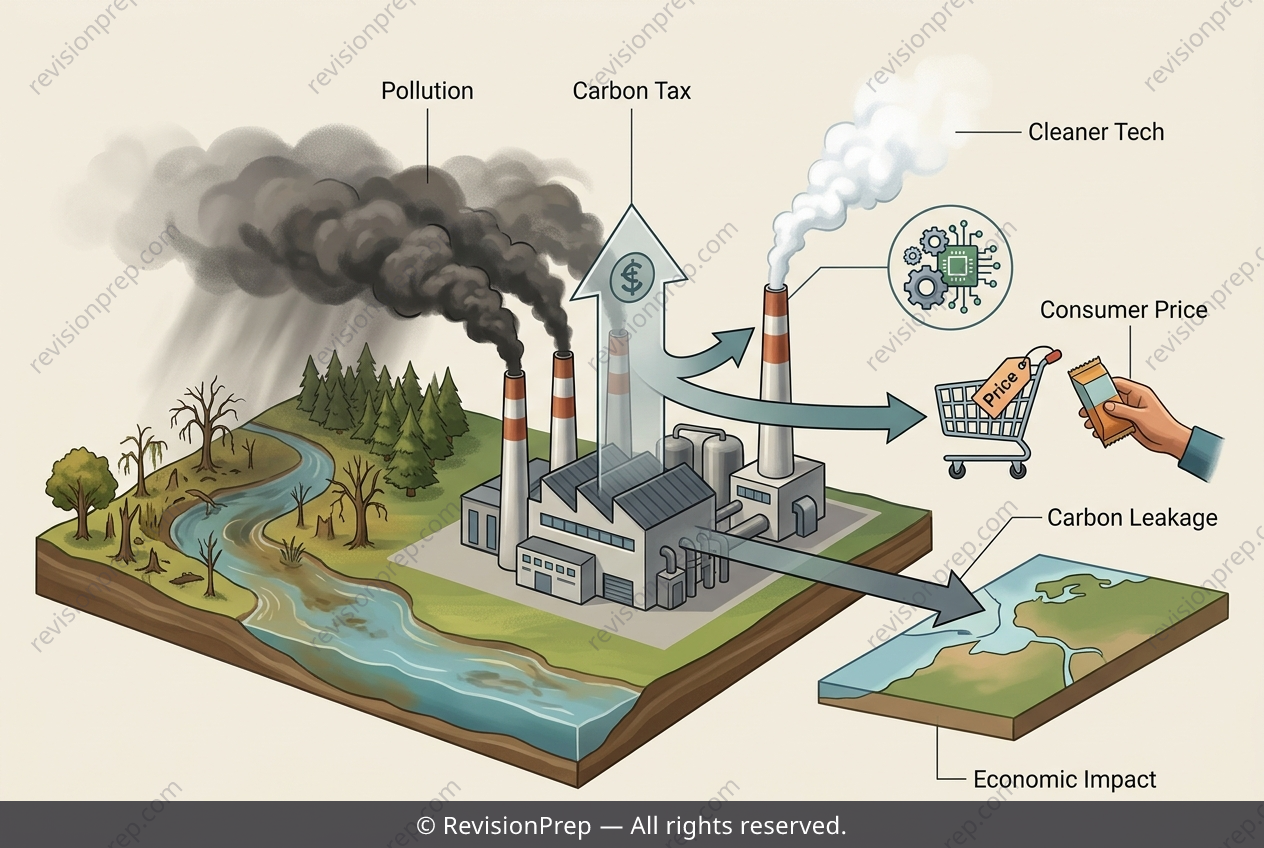
When a market ignores the side effects of production, the price of a good rarely tells the full story. That hidden cost—like the damage from CO₂ emissions—is a negative externality, and one of the most elegant tools economists use to fix it is the Pigouvian tax. Named after Arthur Pigou, this tax is set precisely equal to the marginal external cost (MEC), forcing producers to “internalise” the harm they impose on society. The logic unfolds on a standard supply-and-demand diagram. The private marginal cost (MPC) curve sits below the social marginal cost (MSC), with the vertical gap between them representing the MEC. Left alone, the market equilibrium (Qm) occurs where MPC equals MSB, producing too much output and a shaded deadweight welfare loss triangle between Qm and the social optimum Q. A per-unit tax equal to MEC shifts MPC upward to MPC + tax, pushing the private equilibrium to Q, where MSC equals MSB—eliminating the loss. In theory, emissions fall exactly as intended. But as the case of Country Y shows, real-world behaviour—like firms passing costs to consumers or relocating abroad—can blunt the tax’s impact, revealing the gap between elegant models and messy markets.
Start practising IB questions today
150,000+ IB-styled questions, criteria-mapped and instantly accessible.