
Economics: Vietnam — Endowments Shape Distribution
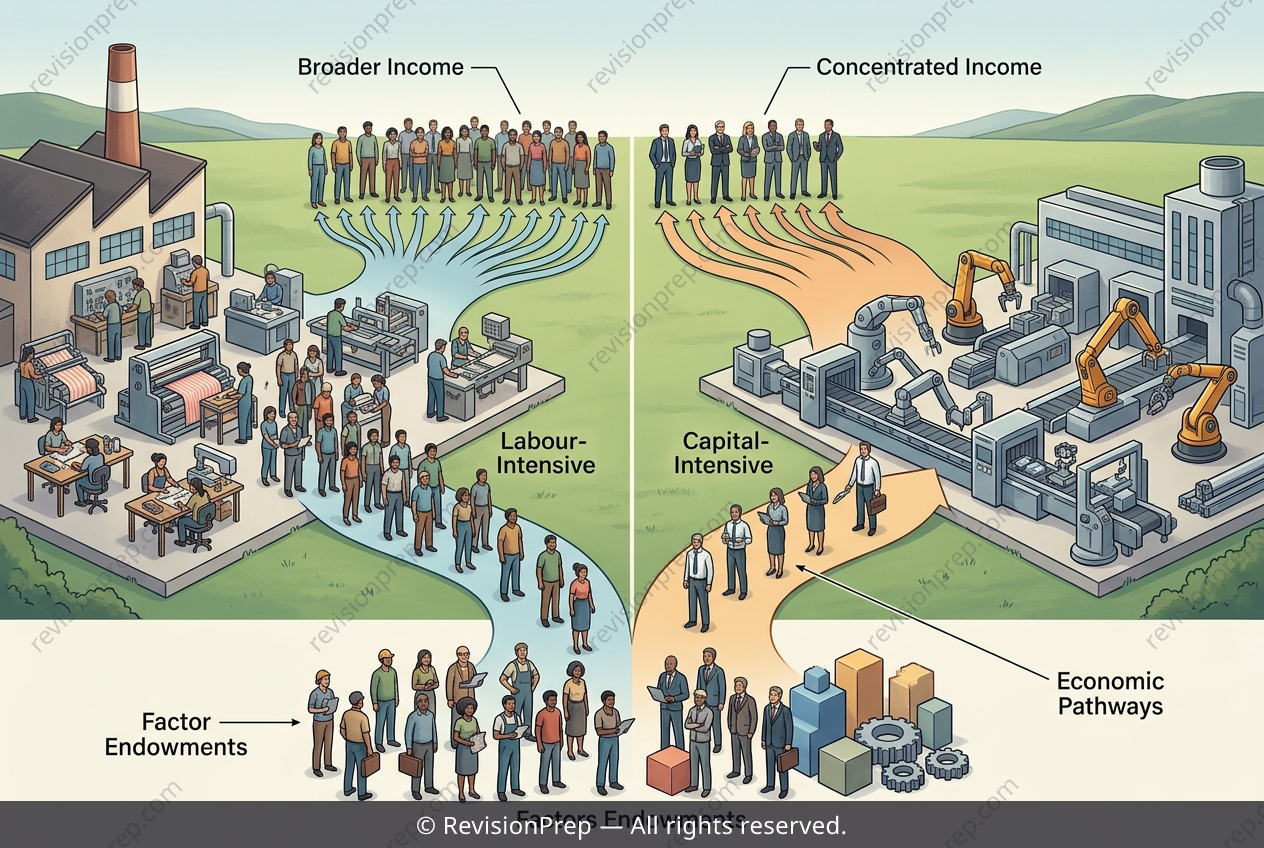
Vietnam’s economic story hinges on a single question: how should a country allocate its resources when its people and its technology are mismatched? At the heart of this is the concept of factor endowments—the quantities and qualities of land, labour, and capital an economy possesses. Vietnam has an abundance of low-skilled labour (70% of workers have secondary education or less) but limited capital stock. This mismatch determines which production methods are viable: labour-intensive industries like textiles (employing 25% of manufacturing workers at USD 300/month) align with the existing endowment, while capital-intensive semiconductor assembly (requiring advanced machinery and skilled labour) does not—at least in the short run. This choice directly shapes income distribution, visualised through the Lorenz curve. The curve plots cumulative percentage of population against cumulative percentage of income, with the 45° line representing perfect equality. Textiles, spreading income across a large workforce, produce a curve closer to that line; semiconductors, concentrating high wages (USD 800/month) among just 5% of workers, push the curve further away. Understanding this connection—endowments → methods → distribution—explains why nations like Vietnam face trade-offs between immediate employment and future technological upgrading.
Start practising IB questions today
150,000+ IB-styled questions, criteria-mapped and instantly accessible.