
Economics: Weighing Costs Behind a Supply Shift
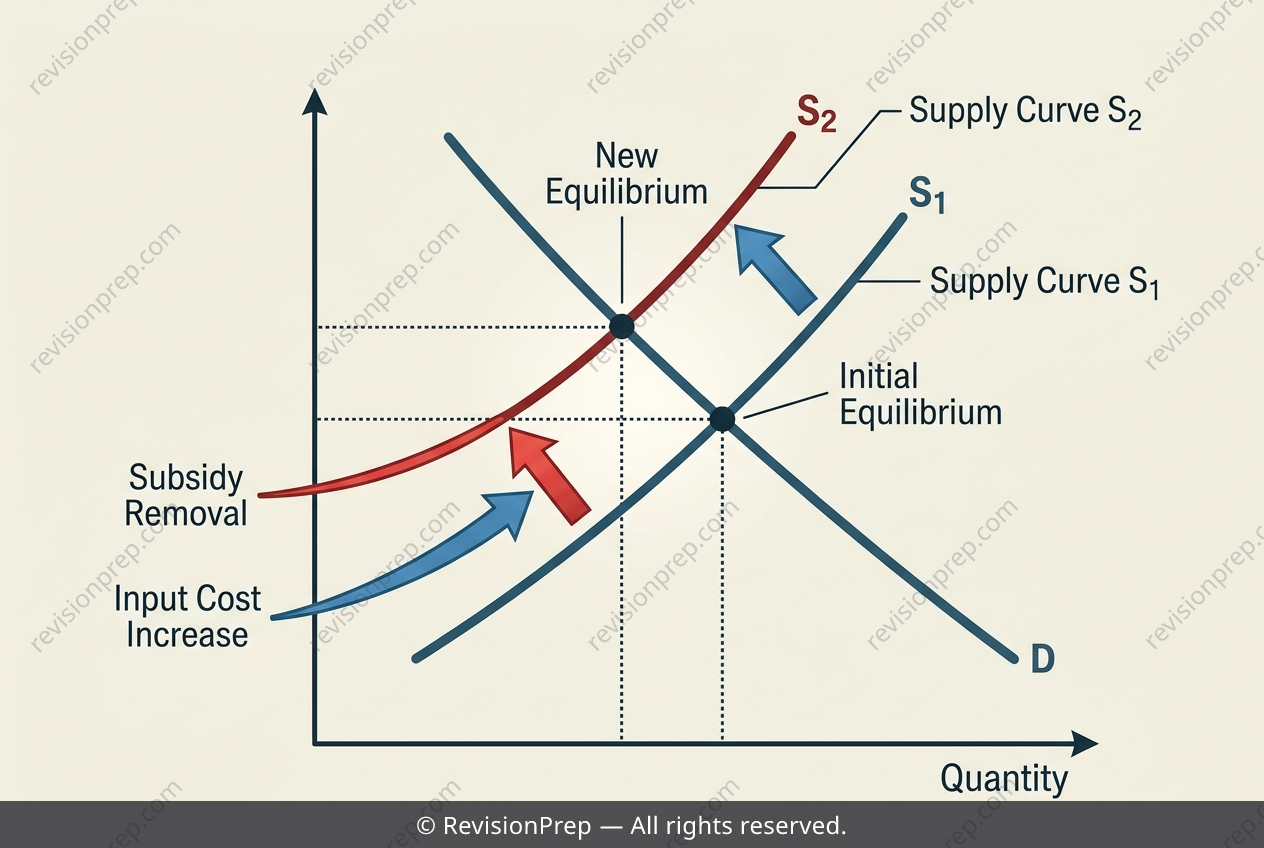
Supply is not a fixed number — it is a relationship between price and the quantity producers are willing to offer, shaped by underlying costs. In the market for fresh milk, the removal of a government subsidy acts as a direct cost shock: a subsidy of USD 0.50 per litre had previously lowered effective production costs at every output level, so its removal shifts the entire supply curve leftward. This means that at any given price, farmers now supply less milk, pushing the market toward a higher equilibrium price and a lower equilibrium quantity. But supply rarely moves for a single reason. Here, a simultaneous 10% rise in cattle feed prices also raises marginal costs, compounding the leftward shift. The key analytical step is comparing the relative magnitudes of these two cost increases. The subsidy removal alone represents a cost rise equal to one-third of the original price, while the feed price increase — being only one input among many — translates into a far smaller per-unit cost change. Understanding how multiple determinants interact to shift supply, and how their relative sizes determine the final equilibrium outcome, is central to microeconomic analysis. It explains why markets adjust, who bears the burden of policy changes, and why isolating one cause from another matters for predicting real-world price and quantity movements.
Start practising IB questions today
150,000+ IB-styled questions, criteria-mapped and instantly accessible.