
Economics: What GDP, GNP, NNP Reveal About National Income
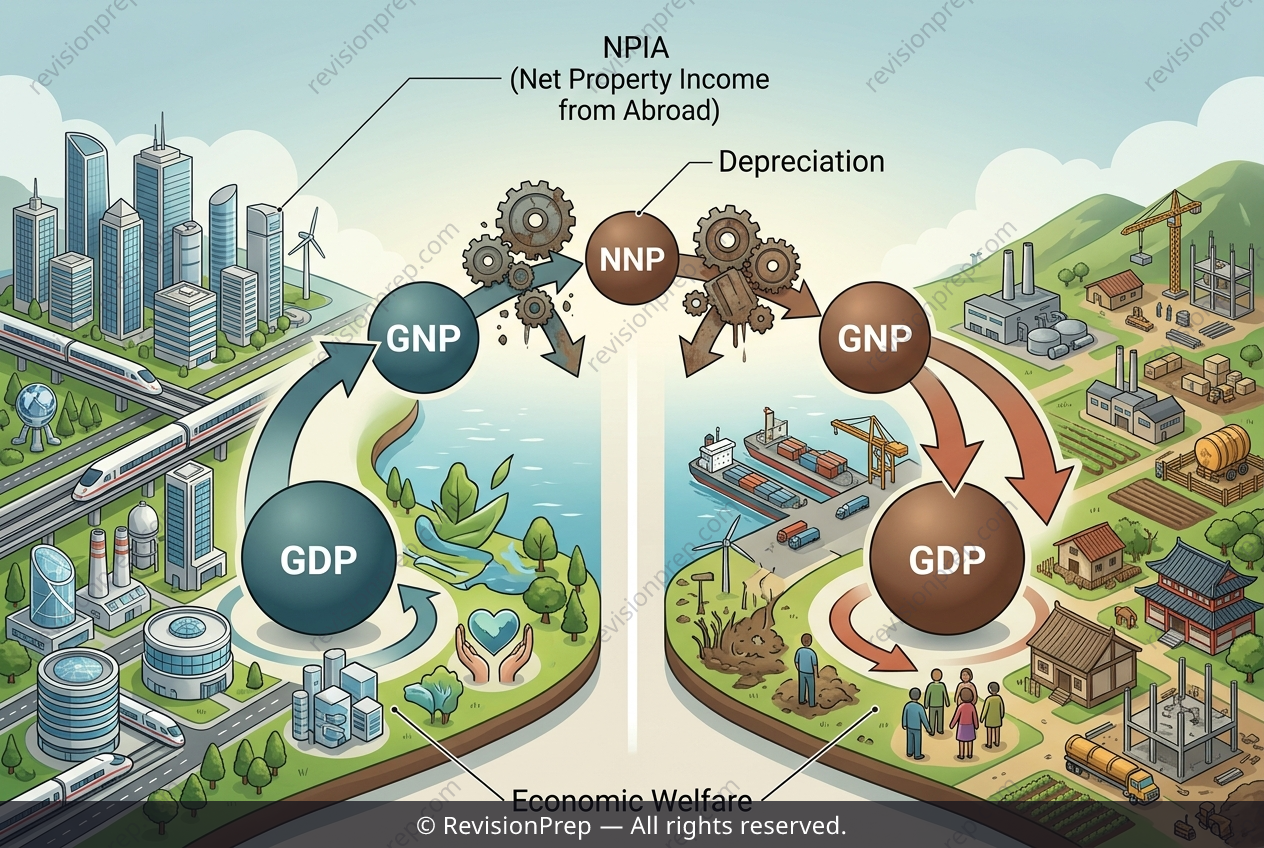
National income accounting provides the framework economists use to measure the total output and income generated within an economy, and to distinguish between what is produced domestically and what ultimately accrues to a country's residents. The key relationships run through three aggregates: GDP captures output produced within a country's borders, GNP adjusts this for net property income from abroad (GNP = GDP + net property income from abroad), and NNP subtracts depreciation from GNP (NNP = GNP − depreciation) to reflect income net of capital consumption. These distinctions matter because they reveal the underlying structure of an economy. A country whose residents own substantial assets overseas tends to record GNP above GDP, as factor income flows inward, while a country attracting large inflows of foreign direct investment often sees profits repatriated abroad, pushing GNP below GDP. Depreciation, meanwhile, signals how much output merely replaces worn-out capital rather than adding to sustainable income. Together, these measures shape how economists judge living standards, making NNP a valuable but imperfect gauge of economic welfare.
Start practising IB questions today
150,000+ IB-styled questions, criteria-mapped and instantly accessible.