
Economics: When Input Prices Challenge Rational Choices
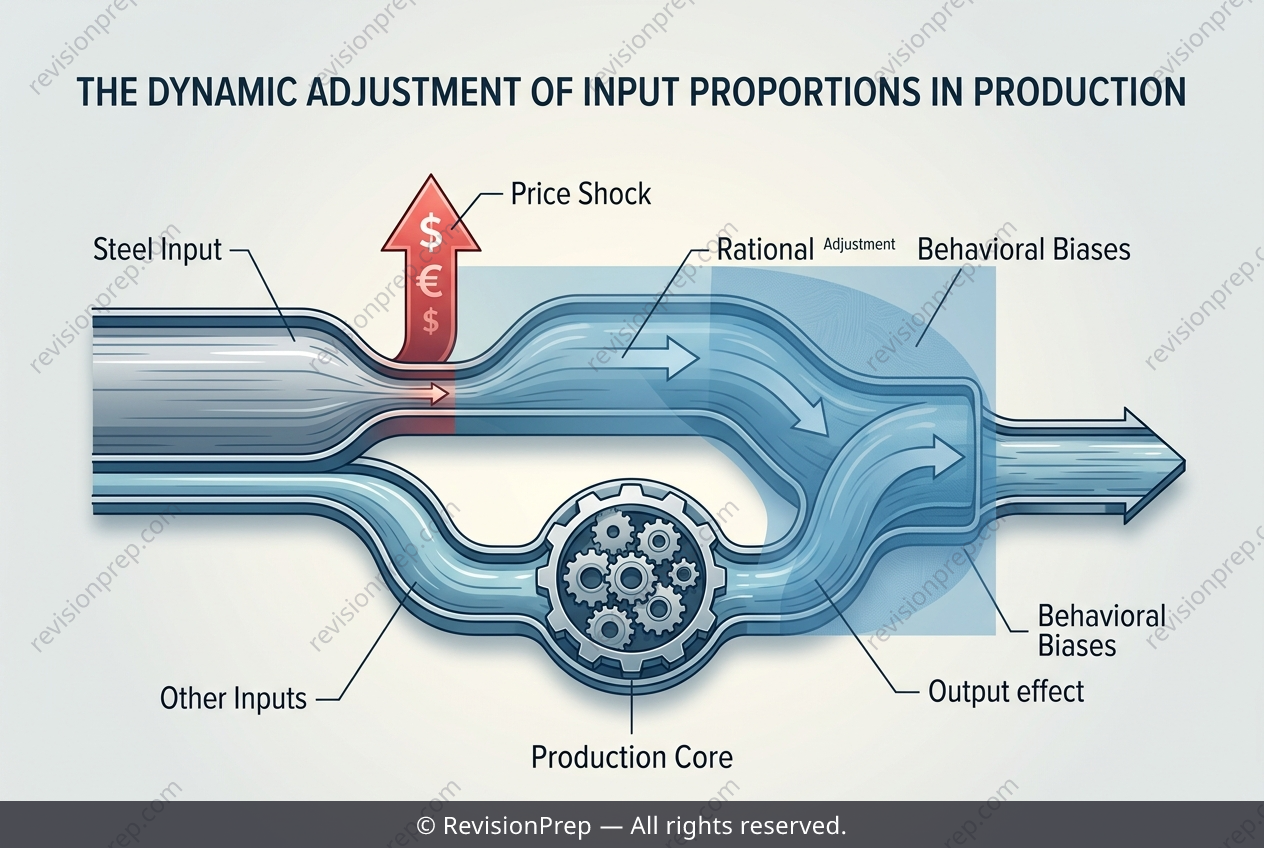
When the EU’s carbon border adjustment mechanism raised imported steel prices by 25%, steel-using firms faced a classic cost-minimisation problem: how to combine inputs to produce the same output at least cost. The rational benchmark rests on the tangency condition MPS / PS = MPL / PL, where a firm adjusts its input mix until the marginal product per euro spent is equal across steel and other inputs. An isocost–isoquant diagram captures this: the isocost line pivots inward on the steel axis, and the firm moves along its isoquant to a new tangency point, substituting away from pricier steel while holding output constant. The scale of that substitution depends on elasticity. Using PED = %ΔQd / %ΔP, a price rise combined with inelastic short-run demand implies only a modest fall in steel quantity, so total steel expenditure still rises. This is where behavioural economics enters: status quo bias and adjustment costs can delay or distort the theoretically optimal response, producing sub-optimal input choices even when the rational model predicts clear substitution.
Start practising IB questions today
150,000+ IB-styled questions, criteria-mapped and instantly accessible.