
Economics: When Price and Costs Pull Supply Apart
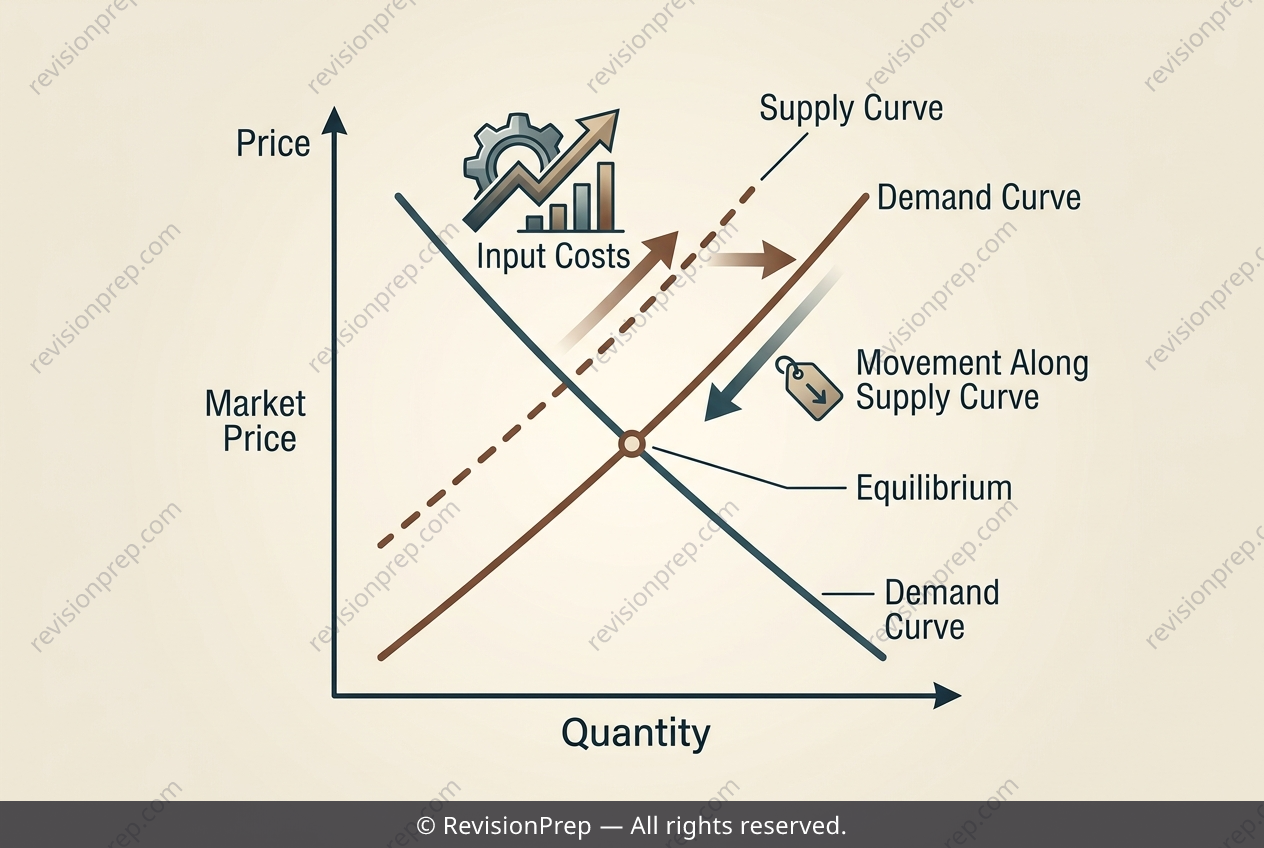
Market equilibrium dynamics is the beating heart of microeconomics—the process by which the forces of demand and supply interact to determine the price and quantity of a good traded in a market. For a price-taking firm in perfect competition, this isn’t just a theoretical abstraction; it’s the daily reality of adjusting output when market conditions shift. In our case, a steel producer’s supply function, Qs = -2000 + 5P - 10Piron, reveals how quantity supplied responds not only to its own price (P) but also to the cost of a key input, iron ore (Piron). Why does this matter? Because real-world shocks rarely arrive alone. When the market price of steel rods falls while the price of iron ore rises, two distinct mechanisms unfold: a movement along the supply curve (a fall in price reduces quantity supplied) and a shift of the entire supply curve (higher input costs push supply leftward). The marking scheme highlights that the combined effect on equilibrium quantity is unambiguous—it falls—but the effect on equilibrium price is ambiguous, depending on the relative strength of the demand-side shock that caused the initial price drop. Understanding how these parts connect—price signals, input costs, and the resulting equilibrium—is essential for predicting market outcomes, whether you’re analysing a steel market or any competitive industry facing simultaneous cost and demand pressures.
Start practising IB questions today
150,000+ IB-styled questions, criteria-mapped and instantly accessible.