
Economics: When Private Costs Hide a Commons Tragedy
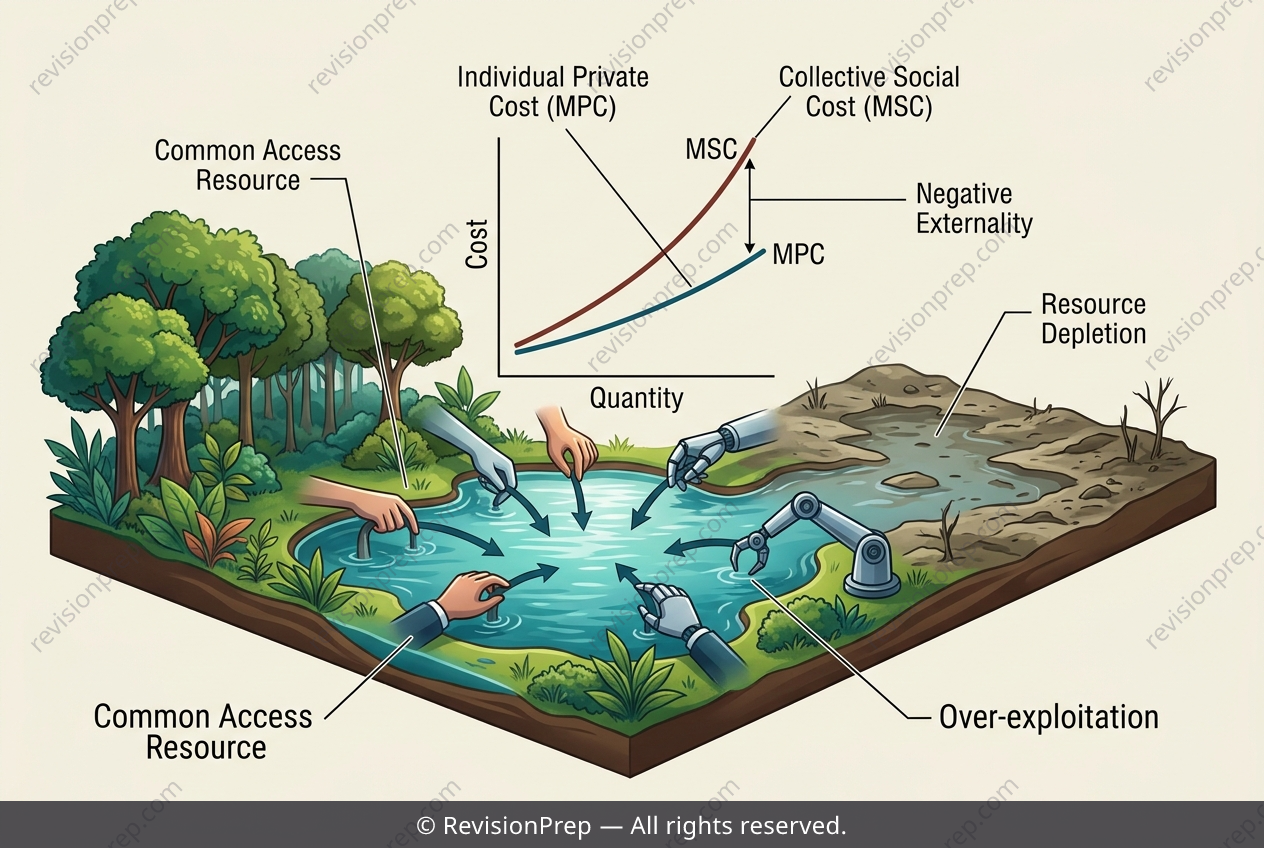
The Grand Banks cod fishery is a textbook case of a common access resource: a good that is non-excludable, meaning no one can be barred from using it, and rivalrous, meaning one person’s catch directly reduces the fish available to everyone else. Because the open ocean defied practical exclusion, thousands of independent trawlers shared a single, finite stock—each acting rationally for themselves while collectively undermining the resource’s future. This is the tragedy of the commons in action. The core mechanism lies in the gap between private and social costs. A fisher’s marginal private cost (MPC) includes only fuel, labour, and nets, but the marginal social cost (MSC) also accounts for the negative externality of stock depletion imposed on all future harvesters. Since the market equilibrium occurs where marginal private benefit equals MPC (QM), while the socially optimal harvest sits where marginal social benefit equals MSC (Q*), overfishing is inevitable: QM exceeds Q*. The 1992 moratorium—after cod biomass fell below 1% of historical levels—shows how ignoring this divergence can push a renewable resource past its tipping point, where recovery may never occur.
Start practising IB questions today
150,000+ IB-styled questions, criteria-mapped and instantly accessible.