
Economics: When Rational Choices Meet Real Behaviour
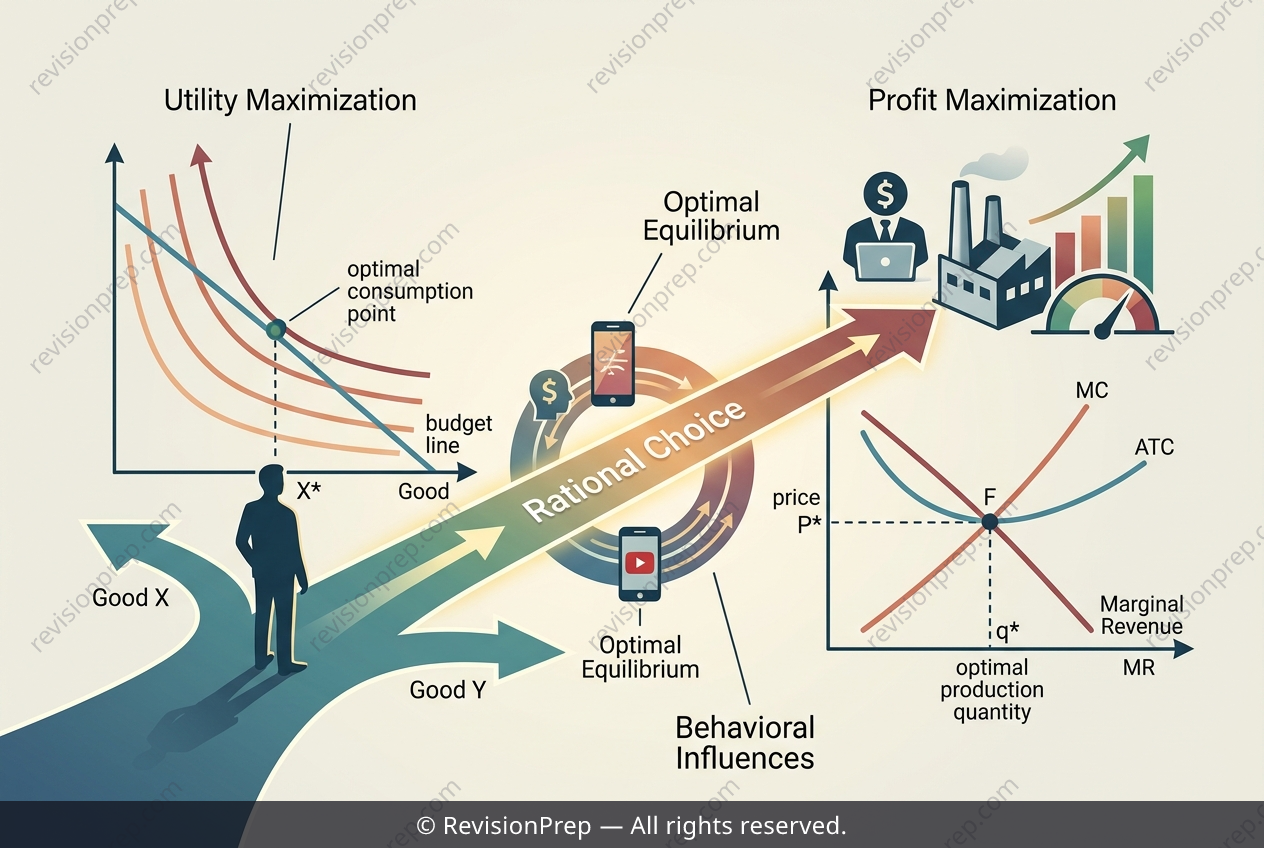
Rational maximization sits at the heart of microeconomics, describing how consumers and firms pursue their objectives under scarcity. Consumers allocate a fixed budget to reach the highest attainable satisfaction, achieved where MUx / Px = MUy / Py, so that the marginal utility per dollar is equal across all goods. Graphically, this optimum appears where the budget line, with slope −Px / Py, is tangent to the highest reachable indifference curve, so MRS = Px / Py. Producers face an analogous logic, maximizing profit where MR = MC. A firm with market power sets output at this intersection, then reads price from demand and average cost from the ATC curve, generating supernormal profit equal to (P − ATC) × Q. Together, these conditions show how rational choices shape market outcomes — and why behavioural economics questions whether real consumers and firms truly behave this way.
Start practising IB questions today
150,000+ IB-styled questions, criteria-mapped and instantly accessible.